
Extra Payment Mortgage Calculator – Free Loan Payoff Planner with Biweekly, Lump Sum & Refinance Options
Use our free Extra Payment Mortgage Calculator to explore how adding extra monthly, biweekly, or one-time lump-sum payments can cut years off your mortgage. Instantly view updated payoff dates, total interest savings, and full amortization schedules — plan smarter, save more, and stay debt-free sooner
Extra Payment Mortgage Calculator
Provided by Lifegic.com
Extra Payment Mortgage Calculator – Pay Off Your Loan Faster
What if you could own your home free and clear, years ahead of schedule? What if a small, extra payment—perhaps the cost of a few weekly coffees or a streaming subscription—could save you tens of thousands of dollars in interest over the life of your loan? It’s not a financial fantasy; it’s a tangible reality made possible by a simple strategy: making extra payments on your mortgage.
Your mortgage is likely the largest debt you’ll ever take on, and the idea of being tied to it for 30 years can feel daunting. But you have more control than you think. The journey to a debt-free home is not just about making your required monthly payment; it’s about understanding how to strategically accelerate your loan payoff. This is where our Extra Payment Mortgage Calculator becomes your most powerful ally.
This comprehensive tool is designed to do more than just crunch numbers. It’s a financial planning dashboard that empowers you to visualize your path to financial freedom. By showing you the direct impact of additional payments, it turns abstract goals into a concrete, achievable plan. Whether you’re a first-time homebuyer eager to build home equity faster, a seasoned property investor optimizing your portfolio, or a financial planner advising clients, this calculator provides the clarity you need.
Forget complicated spreadsheets and financial jargon. Our Extra Payment Mortgage Calculator gives you instant, clear, and actionable insights, helping you see exactly how you can shorten your mortgage term and achieve the dream of homeownership sooner than you ever thought possible.
How This Powerful Calculator Works
At its core, a mortgage is a simple concept: you borrow a large sum of money (the principal) and pay it back over time with interest. However, the way that interest accumulates is what costs you money. Our Extra Payment Mortgage Calculator demystifies this process by showing you how to turn the tables in your favor.
The Logic: Principal, Interest, and Amortization
When you make a standard monthly mortgage payment, it’s split into two parts: a portion that pays down the principal and interest. In the early years of your home loan, the majority of your payment goes toward interest. As time goes on, the balance shifts, and more of your money starts chipping away at the principal. This gradual repayment schedule is known as amortization.
The magic of extra payments lies in how they disrupt this schedule. Every single dollar you pay above your required monthly amount is applied directly to the principal balance. This has two profound effects:
- It Reduces Your Loan Balance Faster: By lowering the principal, you reduce the base amount on which future interest is calculated.
- It Saves You Money: With a smaller principal, you pay less mortgage interest each subsequent month, and ultimately, over the entire life of the loan.
Our Extra Payment Mortgage Calculator models this effect instantly. It takes your loan details and recalculates your entire amortization schedule based on the extra payments you want to make.
What Can You Model with This Calculator?
This isn’t just a tool for one specific scenario. We’ve built it to be a flexible financial sandbox where you can test multiple strategies for an early mortgage payoff.
- Recurring Extra Monthly Payments: See the long-term impact of adding a consistent extra amount—$50, $100, $500, or more—to your monthly payment.
- One-Time Lump Sum Payments: Have a work bonus, inheritance, or tax refund coming your way? The calculator shows you how a single large payment can shave years and thousands of dollars off your mortgage.
- Biweekly Payment Strategy: Explore the popular method of paying half your monthly mortgage every two weeks. This results in 26 half-payments a year, which cleverly adds up to one full extra monthly mortgage payment annually. Our Extra Payment Mortgage Calculator compares this strategy directly against others.
- Refinancing Scenarios: Wondering if refinancing to a lower rate and making extra payments is the right move? You can model that, too.
Best of all, this Extra Payment Mortgage Calculator works entirely within your browser. Your financial information is completely private, and the results are generated instantly, allowing you to experiment with different numbers as much as you like.
Step-by-Step: How to Use the Extra Payment Mortgage Calculator
We designed this calculator to be both powerful and intuitive. To get the most accurate picture of your financial future, simply follow these steps and fill in the fields. Each input helps build a clearer projection of your loan payoff journey.
1. Enter Your Mortgage Details
This first section establishes the baseline for your current home loan.
- Home Price: Enter the original purchase price of your property.
- Down Payment: Input the initial amount you paid upfront. You can enter this as a fixed dollar amount ($) or as a percentage (%) of the home price. The calculator will automatically determine your starting loan amount.
- Interest Rate (%): This is the annual interest rate on your mortgage. Be as precise as possible (e.g., 6.25).
- Mortgage Term (Years): Enter the original length of your loan, typically 15, 20, or 30 years.
- Mortgage Start Date: Select the date your first mortgage payment was due. This is crucial for calculating how much you’ve already paid and your current balance.
2. Define Your Payoff Acceleration Strategy
Here’s where you tell the Extra Payment Mortgage Calculator how you plan to get ahead. You can use one or a combination of these strategies.
- Extra Monthly Payment: This is the heart of the calculator. Use the slider or type in a number to specify how much extra you want to pay each month. Even a small amount can make a huge difference.
- Extra Payment Start Date: Choose the date you plan to begin making these extra monthly payments.
- Pay Biweekly (Toggle): Simply flip this switch to see the impact of a biweekly payments schedule. When enabled, you can also set a start date for this payment frequency.
- Add Lump Sum Payments (Optional): Click the accordion to open this section. You can add one or more one-time lump sum payments. For each one, enter the amount and the date you plan to make the payment. This is perfect for modeling bonuses or other windfalls.
3. Include Optional Details for a Full Picture (Optional)
For the most comprehensive analysis, our Extra Payment Mortgage Calculator allows you to include other housing-related costs. These sections help calculate your total monthly housing expense and can reveal other financial metrics like your APR.
- Mortgage Fees (for APR): Input any fees you paid when you originated the loan, such as origination fees, discount points, or underwriting fees. This helps calculate the Annual Percentage Rate (APR).
- Monthly Housing Costs: Add your annual property taxes, homeowners insurance, and monthly HOA fees or PMI (Private Mortgage Insurance). This provides a true “PITI” (Principal, Interest, Taxes, and Insurance) payment breakdown.
- Refinance Scenario: Thinking about refinancing? Open this section to enter a new interest rate, term, and closing costs to see how it compares to your current loan, especially when combined with an extra principal payment strategy.
4. Click “Calculate” and Interpret Your Results
Once you’ve entered your information, hit the “Calculate Payoff” button. The Extra Payment Mortgage Calculator will instantly generate a detailed report. Here’s what you’ll see:
- Payoff Report Summary: A clear, concise summary at the top tells you exactly how much sooner you’ll pay off your loan and your total interest savings.
- Key Metrics: This dashboard gives you a side-by-side comparison of your new payoff date vs. your original one, total interest paid, and your effective monthly payment breakdown (including P&I, taxes, insurance, etc.).
- Comparison Tab: A powerful table that compares different strategies: your baseline loan, a biweekly-only plan, an extra-payment-only plan, and your combined strategy. This makes it easy to see which approach yields the biggest savings.
- Amortization Tab: View your full, recalculated amortization schedule. You can see, payment by payment, how your balance decreases over time and how much of each payment goes to principal vs. interest.
- Charts Tab: For visual learners, this tab includes a line chart showing your loan balance declining over time (comparing your accelerated plan to the baseline) and a bar chart comparing the total interest paid across different scenarios.
- Timeline Tab: A unique feature that maps out key milestones on your journey, such as your start date, when you’ll reach 50% home equity, and your glorious, debt-free payoff date.
Practical Examples: See the Calculator in Action
The best way to understand the power of this tool is to see it work with real-world scenarios. Let’s explore a few common situations to see how the Extra Payment Mortgage Calculator provides invaluable insights.
Example 1: The Power of a Small, Consistent Extra Payment
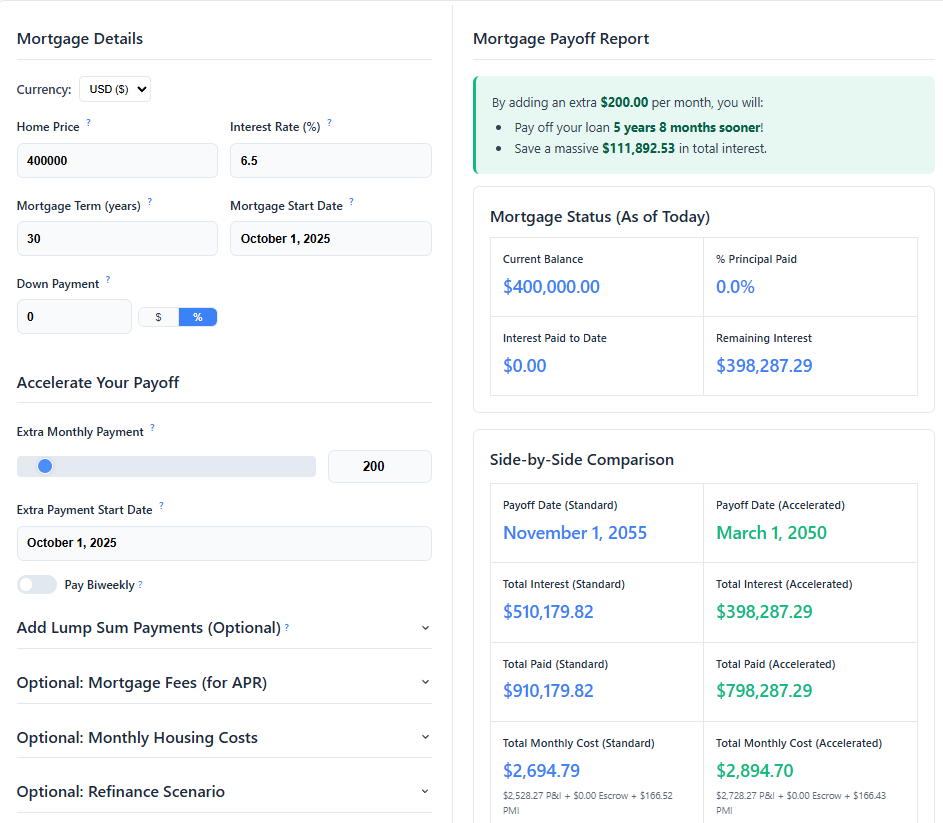
Consider a family with a $400,000, 30-year fixed-rate mortgage at a 6.5% interest rate. Their standard monthly principal and interest payment is $2,528 and total monthly cost along with PMI is $2694.79. They analyze their budget and decide they can afford to add an extra $200 to their payment each month, starting from their very first payment.
- Initial Scenario (No Extra Payments):
- Payoff Date: 30 years
- Total Interest : ~$510,179
- Accelerated Scenario (+$200/month):
- They input their loan details into the Extra Payment Mortgage Calculator.
- In the “Extra Monthly Payment” field, they enter $200.
- They hit “Calculate.”
The Result: By adding just $200 per month, they will pay off their mortgage 5 years and 8 months sooner. Even more impressively, their total interest savings amount to a staggering $111,892. Imagine the financial flexibility gained from that extra money and nearly six years without a mortgage payment.
Example 2: Using a Work Bonus as a Lump Sum Payment
Let’s look at a homeowner who is three years into a $250,000, 30-year mortgage at a 5.8% interest rate. They receive an unexpected work bonus of $15,000 (after taxes). Instead of spending it, they want to make a smart financial move and apply it directly to their mortgage principal.
- The homeowner opens the Extra Payment Mortgage Calculator and enters their original loan details.
- They click to expand the “Add Lump Sum Payments” section.
- They enter $15,000 as the amount and select a date three years after their loan’s start date.
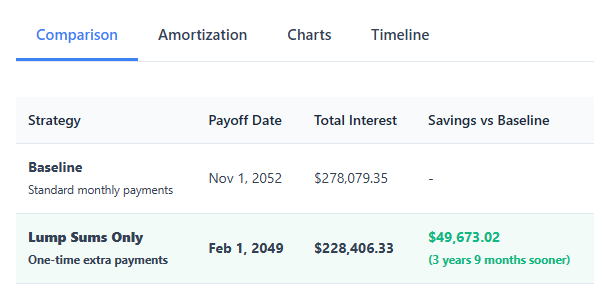
The Result: By applying a one-time $15,000 lump-sum payment after 3 years, the homeowner will pay off their mortgage 3 years 9 months sooner and save $49,673 in total interest — proof that even a single bonus can create lasting financial freedom. This demonstrates that you don’t need a recurring commitment to make a massive dent in your debt.
Example 3: The Biweekly Payments Strategy
A couple has a $320,000, 30-year mortgage at 6.0%. Their monthly P&I payment is approximately $1,919. They’ve heard about the benefits of biweekly payments and want to see if it’s worth the effort of changing their payment schedule.
- Using the Extra Payment Mortgage Calculator, they input their loan information.
- They simply flip the “Pay Biweekly” toggle to “On.”
This strategy works by paying half of the monthly payment every two weeks. This results in 26 half-payments a year, which is equivalent to 13 full monthly payments. That one extra payment per year is applied directly to the principal.
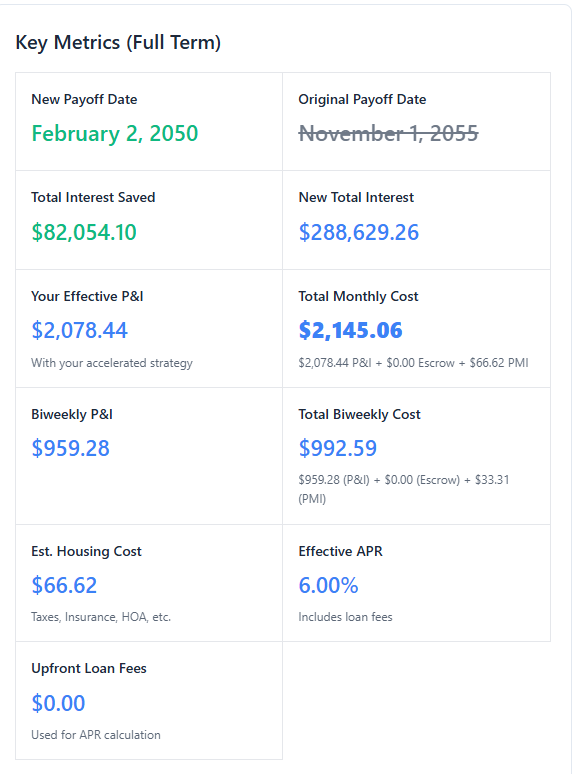
The Result: The calculator’s “Comparison” table shows a clear benefit. By switching to a biweekly schedule, they would pay off their mortgage 5 years and 8 months earlier and save over $82,000 in mortgage interest. The calculator makes the advantage of this common but often misunderstood strategy crystal clear.
Example 4: Combining Refinancing with Extra Payments
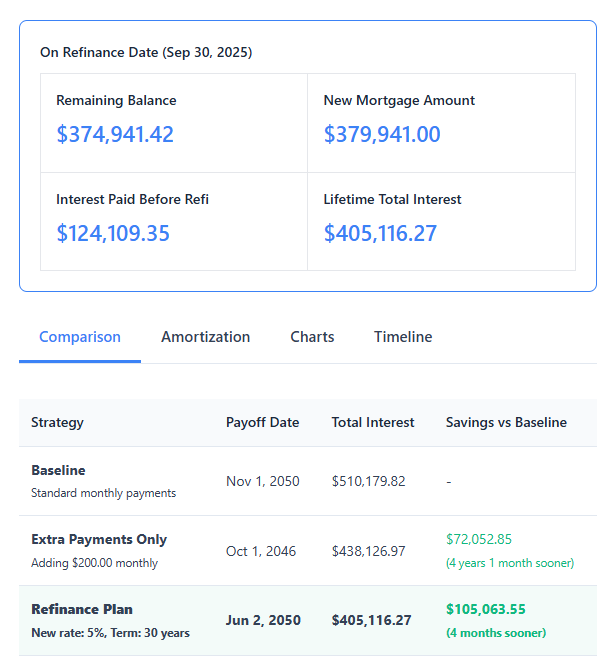
Let’s revisit the $400,000, 6.5% mortgage from the first example. Five years into the loan, the homeowners find that interest rates have dropped. They have an opportunity to refinance their remaining balance (~$374,941) into a new 30-year loan at 5.0%. The closing costs for the refinance are $5,000, which they roll into the new loan. They plan to continue paying an extra $200 per month on the new, refinanced loan.
- They enter their original loan details into the Extra Payment Mortgage Calculator.
- They open the “Refinance Scenario” section and input the new loan details:
- New Interest Rate: 5.0%
- New Mortgage Term: 30 years
- Closing Costs: $5,000
- Refinance Date: 5 years after their original start date.
- They keep the $200 in the “Extra Monthly Payment” field.
The Result: This multi-layered strategy yields powerful results. While refinancing into a new 30-year loan resets the clock on the term, the combination of a much lower interest rate and continued extra payments leads to significant savings. The calculator shows that their lifetime total interest savings compared to the original loan would be approximately $105,063. This complex scenario reveals that even without shortening the loan term dramatically, the interest savings can be substantial, showing how our Extra Payment Mortgage Calculator can handle sophisticated, multi-step financial plans.
Benefits of Using Our Calculator
Understanding your mortgage is the first step toward conquering it. Our Extra Payment Mortgage Calculator is more than a number-cruncher; it’s a tool for empowerment, providing clarity and motivation on your financial journey.
Save Potentially Tens of Thousands in Interest
This is the most significant benefit. Every extra dollar you pay toward principal is a dollar that won’t accrue interest for the next 10, 20, or even 30 years. As the examples above show, these savings can be monumental, freeing up cash for retirement, education, or other life goals. The calculator doesn’t just tell you that you’ll save—it shows you the exact amount, down to the dollar.
Gain Financial Freedom Years Sooner
Imagine life without a mortgage payment. What would you do with that extra money each month? How would your stress levels change? Achieving an early mortgage payoff is one of the most effective ways to build wealth and financial security. This calculator gives you a precise date to circle on your calendar, transforming a vague dream into a definite target.
Visualize Your Progress with Amortization Charts
It can be hard to feel motivated when you don’t see progress. Our calculator’s visual tools, including the loan balance chart and the full amortization table, give you a tangible view of your debt shrinking. Watching that balance line plummet faster with your extra payments is a powerful motivator to stick with your plan.
Test Unlimited “What-If” Scenarios Risk-Free
- “What if I get a raise and can add $150 more per month?”
- “What if I put my entire tax refund toward the house this year?”
- “Is it better to make a $10,000 lump sum payment or increase my monthly payment by $100?”
With the Extra Payment Mortgage Calculator, you can answer all these questions in seconds. It allows you to be the architect of your financial future, comparing different strategies to find the one that best fits your life and goals without any commitment.
Try your own numbers now — see how even $100 extra can change your future! Our easy-to-use Extra Payment Mortgage Calculator is ready for you to explore.
Deep Dive: Mortgage Mechanics Simplified
To truly understand how extra payments work, it helps to know a few fundamental concepts behind your mortgage. Our Extra Payment Mortgage Calculator handles all the complex math, but learning the basics will empower you to make smarter financial decisions.
Understanding Amortization: The Interest-Heavy Beginning
Amortization is the process of paying off a loan through regular, fixed payments over time. What surprises many homeowners is the split between principal and interest in those payments.
On a 30-year mortgage, it’s common for more than 70% of the first year’s payments to go toward interest. This means the lender earns most of their profit in the early years.
That’s why an extra principal payment is so effective, especially at the beginning of the loan. Each additional payment directly reduces the outstanding balance, which in turn reduces the interest charged on future payments. Over time, a larger share of your monthly payment goes toward principal, helping you build equity faster and shorten your loan term.
The Power of Compounding in Reverse
We often hear about the power of compound interest when it comes to investments, where your earnings generate additional earnings over time. In a mortgage, compounding works in the opposite way. Interest is charged on your remaining loan balance, which can make repayment feel slow and costly.
Making extra payments effectively reverses this process. By reducing the principal, you reduce the base on which interest accrues. Each extra payment has a cumulative effect, lowering future interest charges and saving you money month after month.
Extra Payments vs. Refinancing: Understanding the Difference
Both extra payments and refinancing can save you money, but they work in different ways.
- Extra Payments:
A flexible, informal strategy. You can increase your payments, make occasional lump sums, or stop anytime without paperwork, fees, or credit checks. You’re simply paying more than the minimum required amount on your current loan. The Extra Payment Mortgage Calculator is ideal for testing this flexibility. - Refinancing:
This involves replacing your existing loan with a new one—usually to take advantage of lower interest rates or adjust the loan term. It’s a formal process that includes applications, appraisals, and closing costs. While refinancing can reduce your rate and monthly payment, it requires more commitment and upfront effort.
As shown in our fourth example, the most powerful strategy can be to combine both: refinance to a lower interest rate, then continue making extra payments on the new, lower-cost loan to accelerate your payoff even more.
What the Numbers (and Experts) Reveal
It’s not just theory—real financial experts agree on the power of extra payments. According to Investopedia, applying additional amounts directly toward your mortgage principal can dramatically cut down the total interest you pay and shorten your loan term by years.
Think of it as giving your loan an energy boost—each extra dollar you pay works double-time, reducing the interest on every future payment.
Our Extra Payment Mortgage Calculator is built to show exactly how this works with your own numbers—turning financial theory into real, visible savings.
Frequently Asked Questions (FAQ)
Here are answers to some of the most common questions about making extra mortgage payments.
Explore More Financial Tools
Take control of every aspect of your financial life with our suite of free, easy-to-use calculators.
- [Mortgage Payment Calculator]
- [Amortization Chart Calculator]
- [How Much House Can I Afford Calculator]
Your Path to a Debt-Free Home Starts Now
The dream of owning your home outright doesn’t have to be 30 years away. The single greatest tool you have at your disposal is the ability to pay more than the minimum. By doing so, you are not just making a payment; you are buying back your time and your financial future.
This Extra Payment Mortgage Calculator is your roadmap. It empowers you to move from passive borrower to active financial architect. Use it to find a strategy that fits your budget, test your goals, and build a concrete plan for a faster loan payoff.
Don’t wait for a windfall or a “perfect” time. The sooner you start, the more profound the impact will be. Try the calculator above and see for yourself.
Every extra dollar you pay today shortens your mortgage tomorrow.