
Compound Interest Calculator | Daily, Monthly & Tax-Adjusted Growth
Calculate compound interest with daily, monthly, or continuous compounding. See your total growth after taxes and inflation with clear charts and yearly breakdowns.
Ever look at your savings account and wonder how it really grows? We all dream of our money working for us, but it’s often hard to picture what that means. You hear stories about people who started with a small amount and ended up with a fortune decades later. It sounds like magic, but it’s not. It’s a mathematical principle, and it’s the most powerful force in finance: compound interest.
The hard part is seeing it in action. Sure, you can let your money sit for 30 years and be surprised, but that’s not a plan. A plan is knowing what to expect. That’s where this compound interest calculator comes in. It’s a tool that pulls back the curtain on your financial future. It takes the guesswork out of saving and investing by showing you, in clear numbers and charts, how your money can build on itself.
This free online compound interest calculator helps you see the direct impact of your decisions. What if you save $100 more each month? What if your interest rate is 7% instead of 6%? What if you start today instead of next year? These small changes can lead to massive differences down the road. This tool isn’t a crystal ball, but it’s the next best thing for planning your financial journey.
What is Compound Interest (Explained Simply)
What is Compound Interest (Explained Simply)
So, what is this magic? It’s simple, really. Compound interest is just earning interest on your interest.
Let’s use a quick example. Imagine you have $100 in a savings account that pays 10% interest per year.
- Year 1: You earn 10% on your $100, which is $10. Your new balance is $110.
- Year 2: Here’s the magic. You don’t earn 10% on your original $100 again. You earn 10% on the entire balance of $110. That means you earn $11 in interest. Your new balance is $121.
- Year 3: You earn 10% on $121, which is $12.10. Your new balance is $133.10.
That extra $1 in Year 2 and $2.10 in Year 3 might not seem like much, but that’s the “compounding” part. That’s the interest on interest formula in action. Over 30 or 40 years, that tiny, accelerating growth—that snowball effect is what builds real wealth. You are, quite literally, getting paid for the money your interest already earned.
Unlike simple interest — which gives you a fixed return every year and would leave you with only about $130 after 3 years on a $100 principal at 10% — compound interest lets your money grow faster by earning “interest on interest.” That small difference creates a powerful snowball effect over time, turning even modest savings into significant wealth. As explained by Investopedia, compound interest is a key principle behind long-term investing and one of the most effective ways to build wealth over time.
When you compute compound interest, you’re calculating the result of this powerful snowball effect. And the easiest way to do that is with a compound interest calculator.
Why Use a Compound Interest Calculator
You could, in theory, compute compound interest by hand. You could take out a piece of paper and calculate your new balance for every single month for 30 years. But… why would you?
The math gets complicated, fast. Especially when you add in variables like regular monthly contributions, or your contributions growing each year, or different compounding frequencies. The compound interest formula becomes a beast.
This is why a compound interest calculator is an essential tool. It replaces guesswork with clarity.
- It Saves You Time: It performs thousands of calculations in an instant. What would take you hours of manual math (and probably a few mistakes), this compound interest calculator does in less than a second.
- It Gives You Clarity: The most powerful feature is seeing the final number. Knowing that $5,000 plus $200 a month could become $250,000 gives you a concrete goal to aim for.
- It Lets You Compare Scenarios: This is the big one. You can run “what-if” scenarios.
- “What if I find an investment with an 8% return instead of 6%?”
- “What’s the difference if I contribute $300/month instead of $200?”
- “What happens if I wait 5 more years to start?” (Hint: the result is often shocking).
- It Visualizes Your Growth: A good compound interest calculator doesn’t just give you a final number. It shows you charts. You can visually see how, in the early years, your contributions (the blue bar) do most of the work. But in the later years, your interest (the green bar) takes over and starts growing faster and faster.
This tool transforms compounding from a vague theory into a personal, tangible roadmap.
Try adjusting the interest rate or duration in the calculator above — see how even a small change reshapes your future balance.
How the Calculator Works (Behind the Numbers)
This compound interest calculator might look simple, but it handles a lot of complex variables to give you an accurate picture. When you plug in your numbers, here’s what the tool is doing.
Initial Investment (Principal) This is your starting point. It’s the lump sum of money you have to invest or save right now.
Annual Interest Rate (Rate) This is the growth engine. It’s the percentage your money earns each year. A 7% rate means your money is projected to grow by 7% annually. Keep in mind, for investments like stocks, this is an average annual return, not a guarantee. For a savings account, it’s a more fixed APY.
Investment Duration (Time) This is, without a doubt, the most important ingredient for compounding. The longer your money has to grow, the more time the interest on interest formula has to work its magic. The “compounding curve” is exponential, meaning the biggest growth happens in the final years.
Compounding Frequency (n) This setting is key. It asks: “How often is your interest calculated and added to your balance?”
- Annually: The interest is added once per year.
- Monthly Compounding: The interest is added 12 times per year. This is very common for high yield savings accounts.
- Daily: The interest is added 365 times per year. This will result in slightly more growth than monthly compounding.
- Continuous: This is a theoretical concept from calculus, using the continuous compound interest formula (A=Pert), which represents the absolute maximum possible growth if interest were compounded every single instant. A daily compound interest calculator gets very, very close to this number.
The more frequent the compounding, the faster your money grows, because your interest starts earning its own interest sooner.
Contribution Amount & Frequency This is where you turn your investment into a savings plan. You’re not just letting a lump sum grow; you’re adding to it regularly (e.g., $300 every month). This compound interest calculator adds each contribution and immediately starts compounding it.
Advanced: Tax and Inflation This is what makes this compound interest calculator a realistic planning tool.
- Inflation: $100,000 in 20 years won’t buy what $100,000 buys today. Inflation “erodes” the purchasing power of your money. This calculator can show you the “Inflation-Adjusted Value” (your money’s value in today’s dollars) so you have a realistic sense of your future wealth.
- Tax: If your investments are in a taxable brokerage account, you’ll likely owe taxes on your interest and gains. This calculator lets you input an estimated tax rate, and it will show you your after-tax final value. This is a crucial, and often overlooked, part of financial planning.
By combining all these factors, the compound interest calculator provides a comprehensive and personalized projection.
Formula Breakdown Section
For those who want to peek under the hood, let’s look at the math. The calculator saves you from having to do this, but it’s good to know where the numbers come from.
The most basic compound interest formula calculates the future value of a single lump sum (your initial investment).
A=P(1+r/n)nt
- A = The future value of the investment/loan (your final amount)
- P = The principal amount (your initial investment)
- r = The annual interest rate (as a decimal, so 7% = 0.07)
- n = The number of times that interest is compounded per year (e.g., 12 for monthly)
- t = The number of years the money is invested for
Now, what happens when you add regular contributions (like $200 a month)? The formula gets much, much more complex. It becomes:
A=P(1+r/n)nt+PMT x ((1+r/n)nt−1)/(r/n)
- PMT = The regular payment (contribution) amount.
And this still doesn’t account for contributions that grow over time, or taxes, or inflation. You can see why a compound interest calculator is the preferred tool for anyone who isn’t a math professor.
The core difference in simple vs compound interest is right in that formula. The simple interest formula is just:
A=P(1+rt)
Notice the “t” (time) is just a multiplier. It’s linear growth. In the compound interest formula, “t” is an exponent. That’s what creates the explosive, exponential growth curve.
How to Use the Calculator: Step-by-Step
Using this compound interest calculator is straightforward. Let’s walk through it.
Step 1: Your Starting Point
- Currency: Select your currency ($, €, ₹, etc.).
- Initial Investment: Enter the amount of money you’re starting with. If you’re starting from scratch, just enter $0 or $1.
Step 2: Set Your Growth
- Annual Interest Rate %: Enter your expected annual return. For a high-yield savings account, this might be 4-5%. For a stock market index fund, a long-term average might be 7-10%. Be realistic!
Step 3: How Long?
- Investment Duration: Enter the number of Years and Months you plan to let your money grow. This is a crucial field. Try entering 10 years, and then 20, and then 30, just to see the difference.
Step 4: How Often?
- Compounding Frequency: Choose how often your interest compounds. For most savings accounts, “Monthly” is correct. For investments, “Annually” is a common way to model returns. If you want to see the best-case scenario, you can select “Daily.”
Step 5: Add Regular Savings (Optional) This is where you can see the real power of consistent saving.
- Contribution Amount: How much will you add?
- Contribution Frequency: How often? (e.g., “Monthly”)
- Contribution Timing: Do you add the money at the “Beginning” or “End” of the month? (Beginning gives it slightly more time to grow).
Step 6: Click ‘Calculate’ In an instant, the compound interest calculator will figure compound interest for you. It will show you a full results breakdown, including your final value, total contributions, and total interest earned.
Advanced (Optional but Recommended):
- Click the “Advanced Settings” accordion.
- Contribution Growth Rate: If you plan to increase your contributions by, say, 3% each year (to match a raise), enter “3”.
- Tax on Interest %: If your account is taxable, enter your estimated tax rate on gains (e.g., “15” for 15%).
- Annual Inflation Rate %: Enter an average inflation rate (e.g., “2.5” or “3”) to see your “Inflation-Adjusted” final value.
This compound interest calculator is designed to be both simple for a quick look and powerful for a detailed financial plan
Visualize Your Growth — Compound Interest in Action
Numbers on a page are one thing, but seeing your growth visually is what really makes the concept click. When you use the compound interest calculator, the results section gives you clear charts and a detailed breakdown.
The Growth Over Time chart is my favorite. It’s a stacked bar chart comparing your Total Principal (the money you contributed) against your Compound Interest (the money your money earned).
- In the early years, the blue “Principal” bar is much taller than the green “Interest” bar — your contributions are doing most of the work.
- In the later years, the green “Interest” bar suddenly overtakes the blue one. That’s the famous compounding curve in action — your money is now earning more than you ever put in.
The Final Value Composition pie chart shows the same story from another angle. It breaks down your final balance into three slices:
- Initial Investment
- Total Contributions
- Total Compound Interest
For long-term savings, it’s incredibly motivating to see that the “Interest” slice often becomes the largest piece of the pie — bigger than all the money you invested yourself!
Finally, the Amortization Schedule is a year-by-year (or summary) table. This acts as a cumulative interest calculator, showing you the starting balance, contributions, interest earned, and ending balance for each year. You can pinpoint the exact year your interest earnings start to outpace your contributions.
Let’s run a few examples using the compound interest calculator to see this in practice.
Example 1 – Monthly Compounding on a Long-Term Investment
Let’s see what happens to a simple, one-time investment.
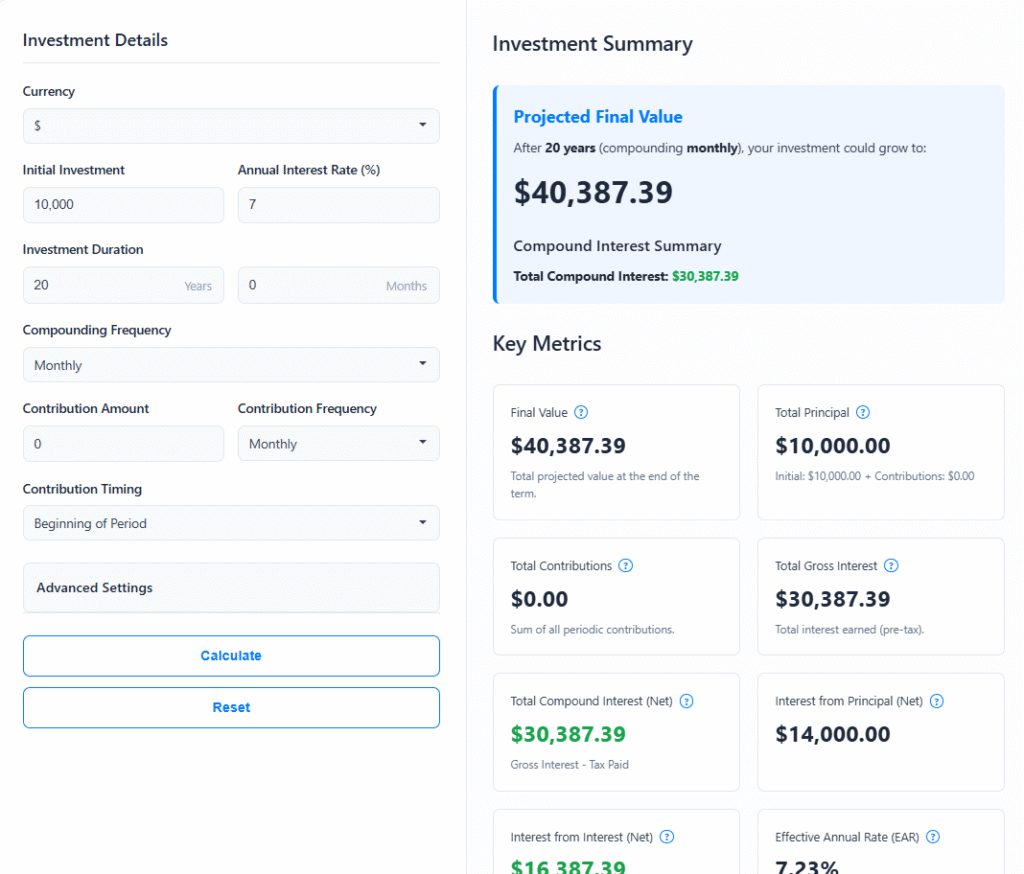
- Scenario: You have $10,000 to invest. You don’t add any more money to it.
- Initial Investment: $10,000
- Contribution Amount: $0
- Annual Interest Rate: 7%
- Investment Duration: 20 Years
- Compounding Frequency: Monthly Compounding
Result: After 20 years, your initial $10,000 would grow to $40,387. You put in $10,000, and you earned $30,387 (pre tax) in pure interest. You’ve quadrupled your money by doing nothing but letting it sit. This is the classic “set it and forget it” power of compounding.
Exploring Frequency: Daily, Monthly, and Continuous Compounding
Now, let’s ask a common question: how much does the compounding frequency really matter? We just ran our example with monthly compounding. What if it compounded daily?
A daily compound interest calculator will always produce a slightly higher result than a monthly one. Why? Because the interest it earns on Day 1 starts earning its own interest on Day 2. In a monthly model, you have to wait until the end of the month for that to happen.
It’s a small difference, but it’s not zero. The most extreme example, as we mentioned, is continuous compounding, which uses the continuous compound interest formula (A=Pert). This is the absolute theoretical maximum.
Let’s run a comparison.
Example 2 – Daily vs Monthly Compounding Comparison
We’ll use the exact same scenario as before.
- Scenario: $10,000 initial investment, $0 contributions, 7% rate, 20 years.
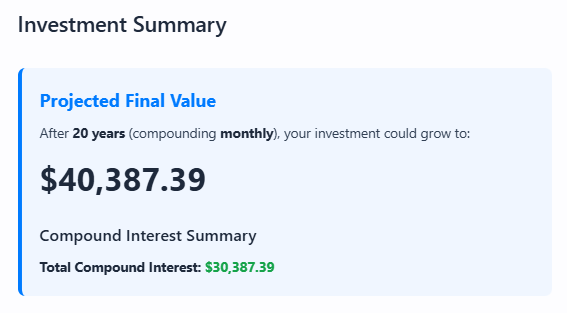
- Result (Monthly Compounding): $40,387.39
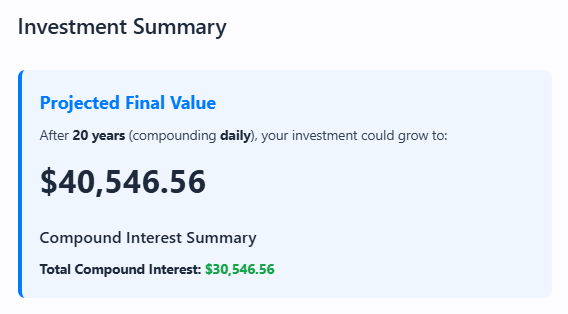
- Result (Daily Compounding): $40,546.56
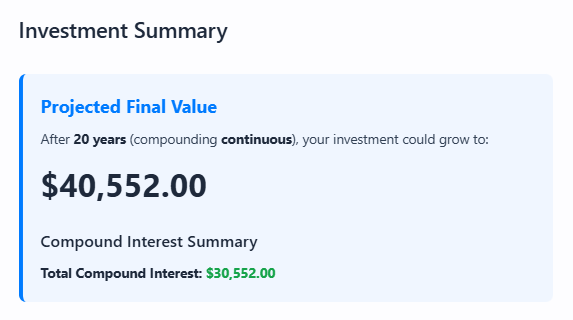
- Result (Continuous Compounding): $40,552.00
As you can see, the difference between monthly compounding and daily compounding over 20 years on $10,000 is about $159. The difference between daily and the “perfect” continuous formula is less than $8.
The takeaway: Frequency matters, and daily is better than monthly. But the difference is tiny compared to the real drivers of your growth: Time and Interest Rate. Don’t stress over finding a daily compounding account if a monthly one offers a better rate. A daily compound interest calculator is useful for precision, but the big picture remains the same.
Adding Contributions and Growth
This is where the numbers get truly exciting. So far, we’ve only looked at a single lump sum. But most of us build wealth by saving a little bit every single month.
When you add regular contributions, this tool becomes a compound savings calculator. You aren’t just growing one snowball. You’re adding a new small snowball every month, and all of them are rolling downhill and growing at the same time.
Furthermore, this compound interest calculator has an advanced “Annual Contribution Growth” feature. This makes it a true compound growth calculator. Why is this important? Because it’s realistic. Most people don’t save the exact same $300 a month for 30 years. As your career progresses, you get raises. You can afford to save more.
By setting a “3%” contribution growth, you’re telling the compound growth calculator to model a scenario where you increase your monthly savings by 3% each year. This one small feature makes the projection dramatically more accurate and, often, much larger.
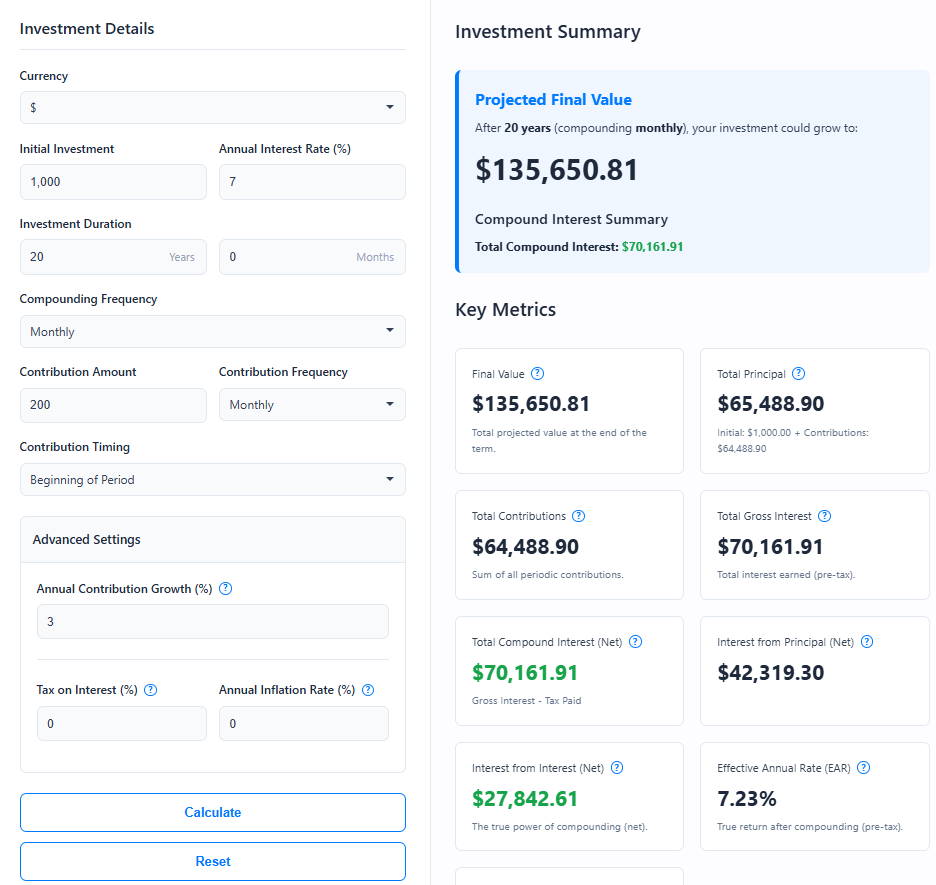
Example 3 – Monthly Contributions with Growth
Let’s see what a realistic, long-term savings plan looks like.
• Scenario: You’re starting with $1,000 and plan to save aggressively.
• Initial Investment: $1,000
• Contribution Amount: $200 (set to “Monthly”)
• Annual Interest Rate: 7%
• Investment Duration: 20 Years
• Compounding Frequency: Monthly
• Advanced > Annual Contribution Growth: 3% (to match your annual raise)
Result: Now, let’s look at the numbers from our compound savings calculator.
• Total Principal: You invested $1,000 initially and contributed a total of $64,488.90 over the 20 years (your monthly contributions gradually increased from $200 to about $353 with 3% annual growth). Your total “out-of-pocket” money is $65,488.90.
• Final Value: Your investment would grow to $135,650.81.
• Total Compound Interest: You earned $70,161.91 in pure interest.
This is the holy grail of saving: the interest you earned ($70k) is now even greater than all the money you contributed ($65k). This is the “crossover point” where your money officially starts working harder than you are — the real power of compound growth in action.
Inflation, Tax, and Real Value
A million dollars isn’t what it used to be. A compound interest calculator that only shows you the “Final Value” is only telling you half the story. That’s the nominal value. You need to know the real value.
Inflation: The Silent Eater Inflation is the rate at which prices for goods and services rise. If inflation is 3%, it means that the $100 that buys you a full cart of groceries today will only buy you $97 worth of those same groceries next year. It silently erodes your purchasing power.
When our compound interest calculator shows you the “Inflation-Adjusted Final Value,” it’s answering a much more important question: “How much will my final balance be worth in today’s dollars?”
If your investment grows by 7% a year, but inflation runs at 3%, your “real” rate of return is only about 4%. This is the number that matters for your retirement planning.
Tax: Your Growth Partner In a perfect world, all your gains would be yours to keep. But in most non-retirement accounts (like a standard brokerage account), your interest earnings are taxable. This is “Net vs. Gross Growth.”
- Gross Growth: Your total return before taxes are paid.
- Net Growth: Your actual, take-home return after taxes are paid.
This compound interest calculator lets you enter a tax rate to see the impact. If you have a 7% return but pay a 15% tax on the gains, your net return is lower. The calculator does this math every compounding period, subtracting the tax before reinvesting the net interest. This gives you a far more conservative and realistic projection of your after-tax wealth.
Tips to Maximize Compounding Power
So, you want to make the numbers on this compound interest calculator as big as possible? Great. There are only a few “levers” you can pull, but they are incredibly powerful.
- Start Now. Time is your single greatest asset. An extra 10 years of compounding can be worth more than doubling your contributions. Don’t wait.
- Stay Consistent. Automate your contributions. Treating your savings like a bill (e.g., $300/month, no excuses) is the most reliable way to build your principal.
- Increase the Rate. The difference between 5% and 8% is massive over 30 years. This doesn’t mean taking on reckless risk, but it does mean exploring investments (like low-cost index funds) that have historically outperformed standard savings accounts.
- Reinvest Everything. If your investment pays dividends or interest, never take it out as cash. Reinvest it immediately. This ensures that money also starts compounding.
- Boost Your Contributions. Every time you get a raise, increase your automatic contribution. Even $50 more a month adds up to tens of thousands of dollars over a career.
- Be Patient. Compounding is a “get-rich-slow” scheme. The most dramatic growth happens in the last few years of a long-term plan. You have to stay invested to see it.
Recalculate your goals now using the compound interest calculator above — small changes today create huge gains later.
Frequently Asked Questions (FAQs)
Explore Other Financial Calculators
Getting a grip on your money involves more than just one number. Compounding is the engine, but you need to understand all the parts of your financial car. If you found this tool helpful, you might also want to check out our other calculators.
- Interest on Interest Calculator: If you want to dig deeper into how your interest grows and see a breakdown of interest-on-principal vs. interest-on-interest, this specialized calculator is for you.
- CD Calculator: Planning for a specific, short-term savings goal, like a car or a down payment? Our CD (Certificate of Deposit) Calculator can help you compare bank rates and see exactly what you’ll earn by a specific date.
- Rate of Return Calculator: If you’re trying to figure out the actual compound annual growth rate (CAGR) of an investment you already own, this is the tool. It tells you your real-world performance.
Seeing your financial future laid out in black and white can be a powerful motivator. It’s not a get rich-quick scheme; it’s a “get-rich-slow-and-steady” plan. And it’s the most reliable plan there is.
Using a compound interest calculator isn’t about predicting a perfect, exact future. No one can do that. It’s about understanding the rules of the game. When you see how much a 1% higher return or five extra years of saving can mean, you start making different decisions. You gain a sense of control. The numbers you see in this compound interest calculator aren’t just data. They’re a map to your goals. They show you what’s possible with discipline, consistency, and, most importantly, time.
The best time to start investing was yesterday. The second best time is right now.
Disclaimer
The results shown by this Compound Interest Calculator are for educational and illustrative purposes only. They are based on the information you enter and use standard financial formulas to estimate potential growth. Actual results may vary depending on factors such as market conditions, taxes, inflation, fees, and changes in contribution habits or interest rates.
This calculator does not provide financial, investment, or tax advice and should not be used as a substitute for professional guidance. Always consult a qualified financial advisor before making investment or savings decisions.