
401k Calculator – With Match, Retirement Growth & After-Tax Balance
Use our free 401k calculator to estimate retirement savings, employer match, and growth. See inflation-adjusted and after-tax results instantly.
401(k) Retirement Calculator
provided by lifegic.com
Thinking About “The Future”? Let’s Make It Less Blurry
It’s a funny thing, “retirement.” We spend decades saving for it, but for most of us, it feels less like a solid plan and more like a fuzzy, far-off idea. You put money into your 401k with every paycheck, you see the balance go up (and sometimes down), but a nagging question often sits in the back of your mind: “Is this… enough? Am I really on track?”
The gap between “saving” and “knowing” is where financial anxiety lives. It’s the uncertainty of not knowing what your $50,000 balance today will actually look like in 30 years. Will it be half a million? A million? Two? And what will that money even be worth after decades of inflation?
This is where the fog starts to clear.
The tool you see above, this 401 k calculator, isn’t a crystal ball. But it’s the next best thing. It’s a powerful projection tool. Think of it as your financial “what-if” machine. It lets you take all those fuzzy variables—your salary, your savings rate, your employer’s match, and your best guesses about the future—and turn them into a concrete, year-by-year estimate. It’s about replacing “I hope I’m doing enough” with “I can see my projected path, and I know what levers to pull to change it.” It’s about clarity. So, let’s pull back the curtain and see exactly how this 401 k calculator works and how you can use it to map out your own future.
What Exactly Is a 401(k), and Why Is It So Powerful?
Before we dive into the calculator, let’s do a quick refresher. A 401k plan is a retirement savings and investment account offered by employers. It’s the most common way Americans save for retirement, and it’s popular for three main reasons:
- Tax Benefits: You get a sweet deal from the IRS. With a Traditional 401k, your contributions are “pre-tax.” This means the money comes out of your paycheck before federal and state income taxes are calculated, which lowers your taxable income for the year. Your money then grows “tax-deferred” for decades. You only pay taxes when you withdraw it in retirement (which our 401k tax calculator feature will help you estimate). With a Roth 401(k), you contribute after tax dollars, but all your withdrawals in retirement—including all the growth—are 100% tax-free.
- The Employer Match: This is the star of the show. Many companies will “match” a portion of your contributions as a work benefit. This is, quite literally, free money. A 401k calculator with match, like this one, is essential because it shows you how this “free money” supercharges your savings.
- Compound Growth: This is the “magic.” Compounding is the process where your investment earnings start to generate their own earnings. It’s a wealth building snowball. A 401k growth calculator is designed to show you this exponential curve, where, over time, the growth of your money can become even more powerful than the contributions you make.
This simple 401k savings calculator combines all three of these powerful forces to give you a comprehensive projection.
How a 401 k Calculator Works Its Magic
At its core, this 401 k calculator is a powerful simulation engine. It’s not just doing one simple calculation. It’s running a year-by-year forecast, from your current age to your retirement age, to see how your balance grows.
Here’s a peek under the hood at what it’s actually doing.
It’s a Story of Your Future, One Year at a Time
When you click “Calculate,” the tool doesn’t just jump to the end. It starts with your Current Age and Current Balance.
- For Year 1: It calculates your salary (based on your Salary Growth assumption), your total employee contribution (based on your Employee Contribution % but capped at the IRS Limit), and your employer’s contribution (based on your Employer Match % and Employer Match Limit %). It adds all that to your starting balance. Then, it applies your Annual Return based on the Compounding Frequency you selected (monthly, quarterly, or annually).
- For Year 2: It takes your new, higher balance from the end of Year 1 and does the exact same thing. It re-calculates your slightly higher salary, your contributions, your match, and then grows the entire pot of money again.
- …and so on: It repeats this process 20, 30, or 40 times until you hit your Retirement Age.
This step-by-step process is what makes a 401k compound interest calculator so much more accurate than a simple “back-of-the-napkin” guess. It accounts for the fact that your contributions (based on your rising salary) and your balance are both growing every single year.
Turning Projections into “Real” Money
A good 401k projection calculator doesn’t just give you a giant, exciting number. It gives you context. That’s where the Inflation Rate and Retirement Tax Rate fields come in.
- Inflation: The tool uses your Inflation Rate to “discount” your final balance. It answers the question: “Sure, I’ll have $2 million in 2055, but what will that $2 million buy in today’s dollars?” This inflation-adjusted number is often the most sobering—and most important—number on the page. We’ll call this your “Real Number.”
- Taxes: If you have a Traditional 401k, the IRS is your silent partner. That final balance isn’t all yours. The 401k tax calculator feature uses your Retirement Tax Rate to estimate how much you’ll have left after you pay taxes on your withdrawals. We’ll call this your “Spendable Number.”
This comprehensive approach, modeling contributions, matches, compounding, inflation, and taxes, is what makes this 401k investment calculator a truly powerful planning tool.
How to Use This 401 k Calculator: A Step-by-Step Guide
Alright, let’s take this for a spin. The best way to learn is by doing. We’ll walk through every single field in the calculator above so you know exactly what to put in.
Step 1: Basic Info (Where You Are Today)
This section sets the stage. Grab your latest 401k statement for this.
- Current Age: Simple enough. Enter your age today.
- Retirement Age: What age do you plan to retire? 65 or 67 are common, but this is your goal. The longer the timeline, the more compounding can work its magic.
- Current Annual Salary ($): Enter your gross (pre-tax) annual income. If you’re not sure, your last paystub (multiplied by your pay periods) is a good place to look.
- Current 401k Balance ($): Log in to your 401k provider (like Fidelity, Vanguard, Schwab, etc.) and find your current total balance. This is your starting point, your “head start.”
Step 2: Contributions (Your Savings Strategy)
This is where you define how much you and your employer are adding to the pot. This is often the most powerful section you can control.
- Employee Contribution (%): What percentage of your paycheck are you contributing? Pro Tip: At a bare minimum, try to contribute enough to get the full employer match. Anything less is walking away from a 100% (or 50%) return.
- Employer Match (%): This is how much your employer matches, as a percentage of your contribution. Common values are 50% or 100%. (e.g., “we match 50%…”).
- Employer Match Limit (%): This is the cap on the match, expressed as a percentage of your salary. (e.g., “…of the first 6% you save.”). In this set, you’d put “6%” here. These two fields (Employer Match % and Employer Match Limit %) work together to define your free money.
- IRS Contribution Limit ($): This is a critical field! The 401 k calculator uses this as a “ceiling” for your employee contributions. For 2025, the base limit is $23,500. If you are age 50 or older, you can make “catch-up” contributions. The calculator tooltip has the exact 2025 “catch-up” limits ($31,000 for ages 50-59/64+ and $34,750 for ages 60-63). Update this field if you are 50+ and plan to save more!
Step 3: Projections & Assumptions (Your Educated Guesses)
This is where you tell the 401 k calculator what to assume about the future. Be realistic here—not overly optimistic, not overly pessimistic.
- Salary Growth (%/yr): What do you expect for an average annual raise? This accounts for cost of living adjustments and merit increases. 2-4% is a common and reasonable assumption.
- Annual Return (%/yr): This is the trickiest one. It’s your average expected return. Past performance isn’t a guarantee.
- Conservative (more bonds): 4-5%
- Moderate (a common stock/bond mix): 6-8%
- Aggressive (mostly stocks): 9-10% (closer to the long-term historical S&P 500 average, but expects more volatility). A 7% return is a very common assumption for a long-term 401k growth calculator.
- Inflation Rate (%/yr): The “silent thief” that erodes your money’s buying power. The long term historical average in the U.S. is around 2.5-3%. Using 3% is a solid, slightly conservative choice.
Step 4: Fine-Tuning Your Results
These last three fields are what turn this from a simple calculator into a true 401k estimator.
- Show inflation-adjusted value (checkbox): Please check this box. This is what activates the 401k inflation calculator feature. It’s the only way to see what your money will actually be worth in today’s dollars.
- Compounding Frequency: How often are your returns calculated? “Annually” is the simplest. However, since your money goes in with every paycheck and your investments fluctuate daily, “Monthly” is a more realistic simulation of how a real-world 401k compound interest calculator should work.
Expected Retirement Tax Rate (%): This is the input for the 401k tax calculator feature. This is your guess for your “effective” tax rate in retirement. This is not your current tax bracket. In retirement, your income might be lower. A 15-20% effective federal + state rate is a common guess, but it depends heavily on where you live and how much you plan to withdraw.
Try It Now: See Your Future Change Instantly
Go ahead, scroll back up and plug in your numbers. Get your first projection.
Now, the fun part. Change one variable. What happens if you bump your Employee Contribution by just 1%? What if you increase the Annual Return by 0.5%? What if you delay your Retirement Age by two years?
Watch the “Projected 401k Balance” jump. This is the power of a 401 k calculator—it instantly shows you the massive, real-dollar impact of small, consistent changes.
Real-Life 401k Calculator Scenarios: How Small Choices Change Everything
Numbers become meaningful only when you see how they play out in real lives.
Below are three realistic examples showing how this 401k calculator with match helps people at different career stages — from early starters to near-retirees, visualize their future growth, match potential, and after-tax outcomes.
Example 1: The Early Starter — Age 25
Profile:
A 25-year-old professional has just begun their career, earning $60,000 per year with an existing $5,000 401(k) balance.
The Plan:
They decide to contribute 10% of their salary, and their employer matches 50% up to 6% of pay.
They plan to retire at 65, expecting a 3% annual salary increase, 7% annual investment return, and 3% inflation.
Their estimated retirement tax rate is 15%.
The Results (from your calculator):
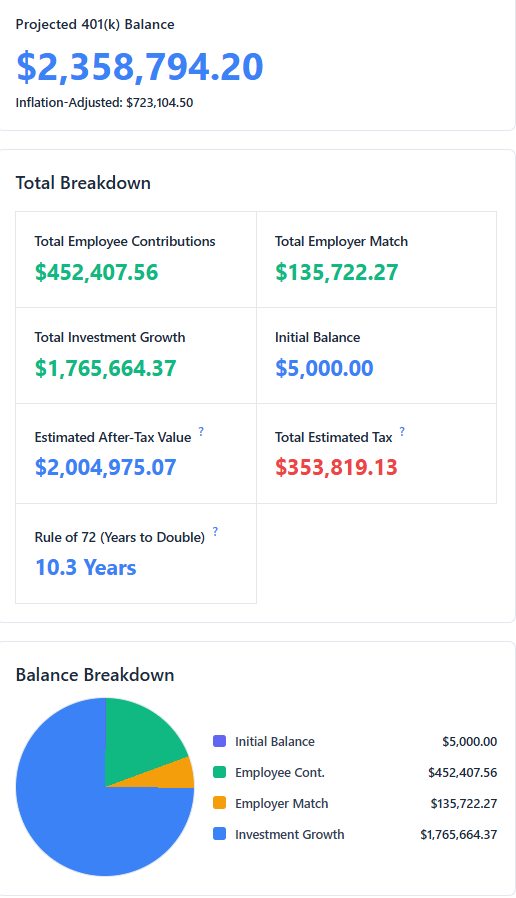
- Projected 401(k) Balance: $2,358,794
- Inflation-Adjusted Balance (today’s dollars): $723,104
- Employee Contributions: $452,408
- Employer Match: $135,722
- Total Contributions: $588,130
- Investment Growth (Earnings): $1,765,664
- Estimated After-Tax Value (15%): $2,004,975
The Insight:
This 401(k) growth calculator clearly shows how powerful long-term compounding is.
Over 40 years, the saver contributes roughly $588 thousand, yet those contributions grow into nearly $2.36 million. After accounting for taxes, the retirement account would hold about $2.0 million. In today’s dollars, that equals roughly $723,104 in real purchasing power.
Example 2: The Mid-Career Maximizer — Age 40
Profile:
At 40, a professional earns $110,000 per year and has already accumulated $150,000 in a 401k. He plans to retire at 67, expects a 3% annual salary increase, a 7% investment return, and 3% inflation. His estimated retirement tax rate is 15%, and his company offers a 100% employer match up to 6% of salary.
Scenario A – Current 4% Contribution
| Detail | Value |
| Employee contribution | 4% of salary = $4,400 / year (grows 3% annually) |
| Employer match | 100% up to 6% = $4,400 / year (grows with salary) |
| Time horizon | 27 years (ages 40 → 67) |
| Annual return | 7% compounded annually |
Projected results:
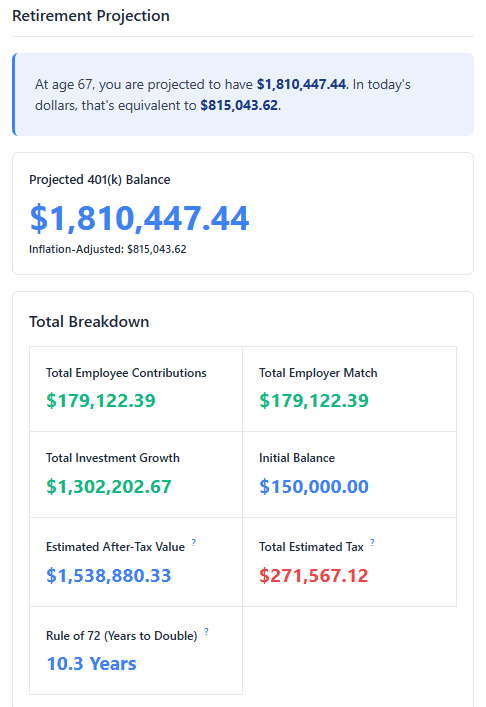
- Final 401(k) Balance: $1,810,447
- Employee Contributions: $179,122
- Employer Match: $179,122
- Total Investment Growth: $1,302,203
- Inflation-Adjusted Balance: $815,044 (Value in today’s dollars)
- After-Tax Value (15%): $1,538,880
Scenario B – Increase to 6% Contribution
| Detail | Value |
| Employee contribution | 6% of salary = $6,600 / year (grows 3% annually) |
| Employer match | 100% up to 6% = $6,600 / year |
| Other assumptions | same as Scenario A |
Projected results:
- Final 401(k) Balance: $2,249,631
- Employee Contributions: $268,684
- Employer Match: $268,684
- Total Investment Growth: $1,562,263
- Inflation-Adjusted Balance: $1,012,759 (Value in today’s dollars)
- After-Tax Value: $1,912,186
The Insight
By increasing his contribution from 4% to 6%, this saver unlocks the full employer match and invests an extra 2% of salary.
That single decision raises total yearly savings from $8,800 to $13,200 and, over 27 years, grows the projected retirement balance by $439,184.
This 401(k) retirement calculator shows how a modest adjustment in savings rate and employer matching can add over $439,000 to a retirement nest egg — without changing jobs or taking on more risk.
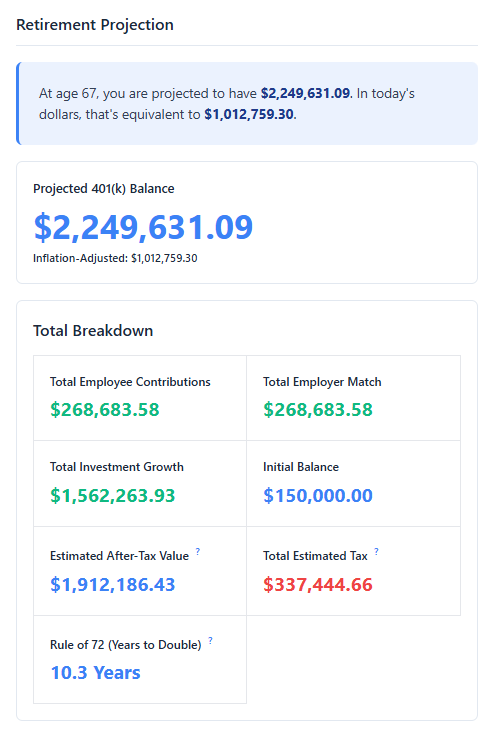
Screenshot of the calculator result for Example 2, showing the $1.81M vs $2.25M
Example 3: The Catch-Up Planner — Age 52
Profile: A 52-year-old earns $180,000 with a $700,000 existing balance. They plan to retire at 67 and want to make the most of catch-up contributions.
The Plan:
- They set the IRS Contribution Limit ($) to $31,000 (the 2025 limit for age 50+).
- They set their Employee Contribution (%) to 18%. This percentage ($32,400) hits the IRS limit, forcing the calculator to use $31,000 as the annual contribution.
- Their employer matches 50% up to 6% of salary.
- We assume a 3% annual salary increase, which causes the employer’s match to grow each year.
- They expect 7% annual returns, 3% inflation, and a 20% retirement tax rate.
The Results:
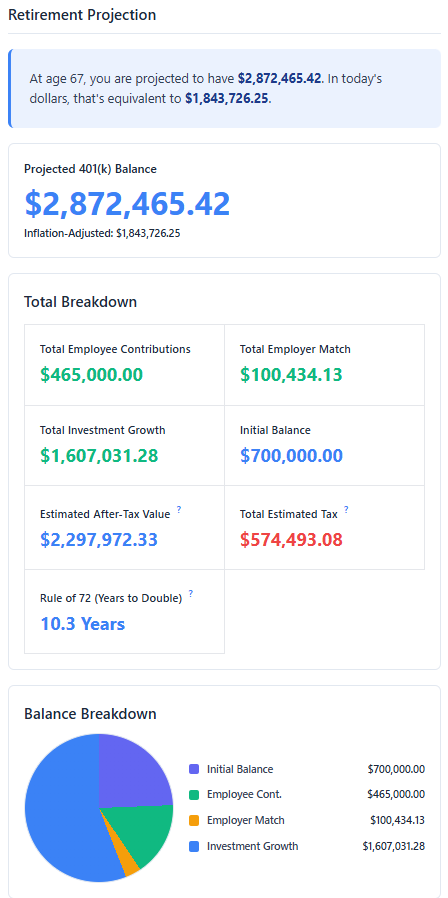
- Projected Balance: $2,872,465
- Initial Balance: $700,000
- Employee Contributions: $465,000 (Total principal over 15 years)
- Employer Match (Total): $100,434 (Total principal contributed over 15 years)
- Total Investment Growth: $1,607,031
- Inflation-Adjusted Balance: $1,843,726 (The value of the final balance in today’s dollars)
- After-Tax Value: $2,297,971 (This is the $2.87M balance after 20% tax, in future dollars)
The Insight: The 401(k) calculator growth projection initially looks impressive — $2,872,464!
But once adjusted for a 20% retirement tax, that future value becomes $2,297,971. Then, after adjusting that amount for 15 years of inflation, the real, spendable purchasing power in today’s dollars is $1,474,984 ($1,843,730 \times 0.80).
That’s still excellent — but it shows how understanding real purchasing power (by accounting for both inflation and taxes) helps plan smarter, not just dream bigger.
Final Takeaway
These examples show what every smart saver learns eventually:
- The earlier you start, the harder your money works.
- Matching contributions are free money you should never leave behind.
- Inflation and taxes are silent factors that define your real retirement income.
Use this 401k calculator with match often — even small contribution changes or salary adjustments can shift your financial future dramatically.
Understanding Your 401k Calculator Results
The final numbers are exciting, but the real value is in the breakdown. Let’s dissect the results from our 401 k calculator so you know what you’re looking at.
The “Big Number”: Projected 401k Balance
This is the headline number. It’s the total nominal value your account is projected to grow to by your retirement age. It’s motivating, but it’s not the full story. Don’t stop here!
The “Real Number”: Inflation-Adjusted Balance
This is arguably the most important number in the entire projection, which is why our 401k inflation calculator feature is on by default. It answers the question, “What will my future nest egg be able to buy?” A million dollars in 30 years will not have the same purchasing power as a million dollars today. This “inflation-adjusted” value shows you its equivalent value in today’s dollars. This is the number you should use for your real retirement planning.
The “Spendable Number”: Estimated After-Tax Value
This is the second-most important number, powered by the 401k tax calculator input. If you’re contributing to a Traditional (pre-tax) 401(k), you haven’t paid taxes on that money yet. When you retire, every dollar you pull out (your contributions and the growth) will be taxed as regular income.
This “After-Tax Value” gives you a realistic, net-worth estimate of what your money is worth after you pay the tax-man. This is especially critical when planning your 401k calculator withdrawal strategy. You don’t live on your gross balance in retirement; you live on your net.
The Pie Chart: Where Did It All Come From?
This visual breakdown is fantastic for understanding how you built your wealth.
- Initial Balance: Your head start.
- Employee Contributions: Your disciplined, hard-earned savings.
- Employer Match: All the “free money” your employer chipped in.
- Investment Growth: The “magic” of the 401k compound interest calculator. For anyone with a long time horizon (like Alex in our example), this slice will likely be the largest one, which is an incredibly motivating thing to see.
The Year-by-Year Table: Your Financial Story
This is my favorite part of the 401 k calculator. By clicking the “Year-by-Year Growth” accordion, you can see the magic happen up close.
- In the early years: You’ll notice your “Employee Cont.” and “Employer Match” are the biggest drivers of growth.
- In the later years: You’ll see a tipping point. The “Growth” column (your investment returns) will suddenly become larger than your contributions. It might even become larger than your entire annual salary. This is the “snowball” reaching critical mass, where your money is doing the heavy lifting for you.
As financial experts often note, consistent contributions and the power of compounding are the undisputed keys to long-term 401k growth.
Frequently Asked Questions (FAQs) About Your 401k calculator
Explore Other Financial Calculators
This 401(k) calculator with match helps you estimate your retirement growth, but true financial confidence comes from understanding how every part of your money works together. As you plan your future, these additional tools can help you make smarter, data-driven decisions:
- Interest on Interest Calculator: Discover how reinvested earnings generate even more returns over time. It’s a great way to understand the compounding force that powers your 401(k) growth.
- CD Calculator: Evaluate how Certificates of Deposit compare to your retirement plan. Find out how fixed interest rates can help preserve and grow your savings safely.
- Compound Interest Calculator: See how consistent contributions and compounding over time can transform small, regular deposits into significant long-term wealth.
- Rate of Return Calculator: Measure your investment performance accurately. Whether it’s your 401(k) or other portfolios, find out how much you’re really earning each year.
Each of these calculators complements your 401(k) retirement planning, helping you see how savings, interest, and growth all connect to build a secure financial future.
The Most Important Number Is the Next One You Enter
It’s easy to feel overwhelmed by the sheer scale of retirement planning. The numbers are big, the timeline is long, and the future is uncertain. But clarity is the antidote to anxiety. A plan, even one based on estimates, is the bridge from a vague wish to a concrete reality.
This 401k calculator is your first step toward that clarity. It’s not just about the final number; it’s about understanding the levers you can pull. It’s about seeing the tangible, million-dollar impact of saving 1% more. It’s about seeing what’s possible when you combine your discipline with the awesome power of time. Don’t just run the numbers once and forget about it. Bookmark this page. Come back once a year. Use this 401k estimator as your annual financial check-up. Tweak the inputs. Challenge yourself. See the future you’re building, one paycheck at a time.
Disclaimer
This 401 k calculator is for educational and illustrative purposes only. The results are hypothetical estimates based on your inputs and assumptions; they are not guarantees of future performance. This is not financial, tax, or legal advice. Please consult a qualified financial advisor to discuss your personal retirement needs.