
CD Calculator – Certificate of Deposit Calculator with Taxes, Penalties, Reinvestment & Inflation
Use our free CD Calculator to estimate your Certificate of Deposit growth. Calculate interest with taxes, penalties, reinvestment, and inflation for accurate after-tax results
Understanding Certificates of Deposit and Why They Matter
A Certificate of Deposit, known universally as a CD, stands as a cornerstone of conservative saving and investment strategies. Offered by virtually every bank and credit union, a CD is a specific type of time deposit account. The fundamental agreement is simple: you, the depositor, agree to lend a lump sum of money to a financial institution for a predetermined period, or “term.” In return for your commitment to not touch these funds for the agreed-upon duration, the institution pays you interest, typically at a fixed rate that is significantly higher than what you would earn in a standard savings or money market account.
This structure creates a trade-off between liquidity and return. While a savings account offers immediate access to your cash, a CD rewards your patience with a better, guaranteed yield. This predictability is a key feature. Unlike investments in stocks or bonds, whose values can fluctuate dramatically with market sentiment, CDs offer a safe harbor. Your principal is not at risk of market loss, and for added security in the United States, deposits are typically FDIC (Federal Deposit Insurance Corporation) insured up to $250,000 per depositor, per institution, for each account ownership category. This federal guarantee makes CDs one of the safest places to grow your money.
The stability of CDs makes them an ideal vehicle for pursuing specific financial goals with a clear time horizon. Whether you’re accumulating funds for a down payment on a house, planning a wedding, or setting aside capital for future business expansion, CDs provide a reliable path. However, the true return on your investment isn’t just about the advertised rate. It’s a complex interplay of the initial deposit, interest rate, term length, compounding frequency, and crucial external factors like taxes and inflation. This is precisely why a sophisticated CD Calculator is not just a convenience, but an essential tool for any serious saver. A comprehensive Certificate of Deposit Calculator allows you to cut through the noise and see a realistic projection of your financial outcome.
What is a CD Calculator?
A CD Calculator is a specialized financial modeling tool designed to provide a clear, accurate, and detailed projection of a Certificate of Deposit’s growth over time. It moves far beyond the limitations of a simple interest formula to create a comprehensive forecast that accounts for the real-world variables that impact your investment. By inputting the specific parameters of your CD, our CD interest calculator simulates its performance, allowing you to see not just the final balance, but the journey your money takes to get there.
The core purpose of a sophisticated CD Calculator is to bridge the gap between an advertised APY and your actual, take-home return. It answers critical questions that a simple calculation cannot:
- How much will I truly earn after federal and state taxes are deducted?
- What is the financial damage if I’m forced to break my CD early?
- How will inflation affect the purchasing power of my savings over the next five years?
- What would my balance look like after 20 years if I consistently reinvest my CD?
By quantifying these variables, a CD Calculator transforms abstract financial concepts into concrete numbers. This fosters a sense of control and clarity, reducing the anxiety that often comes with financial planning and empowering you to make decisions based on data, not just assumptions.
Step by Step Guide: How to Use Our CD Calculator
Using our CD Calculator is an intuitive process designed to guide you from basic inputs to advanced financial modeling. This detailed walkthrough will help you leverage every feature for the most precise results.
- Step 1: Enter Your Initial Deposit This is the starting point of your investment journey. In the “Initial Deposit” field, enter the lump sum you plan to place in the CD. Consider that many banks have minimum deposit requirements, which can range from $500 to $2,500 or more. This figure is the principal upon which all future interest will be calculated in your CD Calculator projection.
- Step 2: Define Your Term Length Next, specify the duration for which your money will be locked in. Choosing the right term is a strategic decision that should align with your financial goals. Use the preset buttons for common terms or input a custom period. A short term (3-12 months) is great for near-term goals, while a longer term (3-10 years) is better for long-range objectives where you want to lock in a favorable rate.
- Step 3: Choose Your Calculation Method (APY vs. Interest Rate) Our CD Calculator provides flexibility in how you input your rate:
- APY (Annual Percentage Yield): This is the standard in the U.S. and the best metric for comparing different CD products, as it includes the effects of compounding. Always use APY when you have it.
- Interest Rate: If you only have the nominal rate (sometimes called APR), select this option. You must then also specify the Compounding frequency. This allows the CD Calculator to accurately calculate the effective yield (APY) behind the scenes. For example, a 5% interest rate compounded daily yields a higher return than the same rate compounded annually.
- Step 4: Model Advanced Scenarios (The Heart of the Calculator) Click the “Advanced Settings” accordion to unleash the true analytical power of this tool.
- Early Withdrawal Penalties: This section turns the CD Calculator into a risk assessment tool. Input your bank’s specific penalty (e.g., 6 months of interest) and a theoretical withdrawal month to quantify the exact cost of breaking your CD.
- Inflation Adjustment: To understand your real return, toggle on the inflation feature. Input a projected annual inflation rate (the historical average is around 3%) to see what your future balance will be worth in today’s dollars. This is a critical step for long-term planning.
- Tax Implications: Input your marginal federal and state tax rates. Our CD calculator with taxes will then project your after-tax earnings. Pay close attention to the sub-options that let you model paying taxes annually from the balance, which reveals the true impact of “tax drag” on your compounding principal.
- Step 5: Simulate Long-Term Growth with Reinvestment For long-term investors, the “Reinvest at maturity” feature is invaluable. This CD reinvestment calculator function lets you model the strategy of rolling over your CD balance into a new one at the end of each term. You can specify how many times you want to roll it over and even input a different APY for future terms, allowing you to model various interest rate scenarios over decades.
- Step 6: Calculate and Analyze Your Comprehensive Results After entering your data, click “Calculate.” The CD Calculator will generate a detailed report featuring a summary of key metrics, powerful visual charts breaking down your earnings, and a precise year-by-year growth table. Take time to review each element to fully grasp your investment’s potential.
Who Should Use This Calculator?
This powerful CD Calculator is a versatile tool designed to provide value to a wide array of individuals, each with unique financial goals and circumstances.
Conservative Savers and First-Time Investors
For those who prioritize safety and are perhaps new to investing, a CD is an ideal first step beyond a basic savings account. This CD Calculator serves as an educational tool, demystifying concepts like APY, compounding, and taxes. It provides a clear, predictable visualization of how savings can grow securely, building confidence and encouraging healthy financial habits without the intimidation of market volatility.
Retirees and Those Nearing Retirement
Capital preservation is the primary objective for retirees. This CD Calculator is an indispensable instrument for this demographic. It allows retirees to model and project a stable, predictable income stream from their nest egg. By inputting various deposit amounts and term lengths, they can determine how CDs can be structured to supplement Social Security or pensions. The inflation adjustment feature is particularly crucial, helping to ensure that their planned income will maintain its purchasing power throughout their retirement years.
Financial Planners and Advisors
Professionals can leverage this comprehensive CD Calculator as a powerful client communication tool. It allows them to quickly model various scenarios, visually demonstrate the long-term impact of taxes and inflation, and create clear, printable reports. Whether illustrating the benefits of a CD ladder or comparing the after-tax returns of a CD to a municipal bond, this calculator adds a layer of data-driven precision to their recommendations.
Goal-Oriented Savers
Anyone saving for a major life event with a specific timeline will find this CD Calculator invaluable. Whether the goal is a wedding in two years, a down payment on a home in five, or a new car in 18 months, this tool allows you to work backward. You can input your target amount and experiment with different initial deposits and APYs to create a tangible, achievable savings plan. It turns a distant goal into a set of concrete numbers.
Business Owners
Businesses often have excess cash on hand that needs to be kept safe and liquid but should still be earning a better return than a standard business checking account. Business owners can use this CD Calculator to determine the potential earnings on their operating reserves, allowing them to make informed decisions about how to best allocate their capital for short- to medium-term periods.
A Deeper Dive into Our CD Calculator’s Advanced Features
The true power of this financial instrument lies in its advanced features, which allow you to move beyond simple projections and into strategic financial modeling.
The Importance of After-Tax Projections
The interest you earn on a CD (unless held in a tax-advantaged account like an IRA) is considered ordinary income and is taxable by both federal and state governments. Forgetting to account for this is a common mistake. Our CD calculator with taxes solves this by allowing you to input your specific marginal tax rates. The result is a projection of your net earnings—the amount you actually get to keep. This is the only figure that matters for accurate financial planning.
Quantifying Risk: The Early Withdrawal Penalty Modeler
The main drawback of a CD is its illiquidity. Our CD calculator with penalty feature turns this abstract risk into a hard number. By inputting your bank’s penalty structure, you can see the precise amount you would forfeit for accessing your money early. This is an essential risk management exercise. It might lead you to choose a shorter term, build a CD ladder for more frequent access to funds, or opt for a no-penalty CD, even if it has a lower APY.
Strategic Long-Term Planning with the CD Reinvestment Calculator
The CD reinvestment calculator feature is designed for modeling long-term strategies, most notably the “CD Ladder.” This strategy involves breaking up your investment into multiple CDs with staggered maturity dates. For example, instead of putting $25,000 into a single 5-year CD, you could put $5,000 each into a 1-year, 2-year, 3-year, 4-year, and 5-year CD. As each CD matures, you reinvest it into a new 5-year CD. This approach provides more liquidity (a portion of your money is accessible each year) and helps you average out interest rates over time. Our calculator is perfectly suited to model the long-term growth of such a strategy.
Preserving Purchasing Power: The Inflation Adjustment Engine
Inflation is the silent erosion of your savings’ value. A 5% return might feel good, but if inflation is at 3.5%, your real return is only 1.5%. Our CD calculator with inflation adjustment calculates the future value of your investment in today’s dollars. This is arguably the most critical feature for anyone saving for a goal that is more than a couple of years away, as it provides a true measure of your progress toward your financial objective.
Example Scenarios with CD Calculator
Let’s explore four practical scenarios to demonstrate how our CD Calculator can provide invaluable insights.
Example 1: Long-Term Reinvestment Strategy
An investor puts $25,000 into a 2-year CD at 5.00% APY, planning to roll it over four more times for a total 10-year investment horizon. They use the CD reinvestment calculator to project growth, assuming future rates also average 5.00%.
- Inputs: $25,000 deposit, 2-year term, 5.00% APY, 4 rollovers, 30% combined tax rate, 3% inflation.
- Results from the CD Calculator:
- Final After-Tax Value: $36,005.64
- Inflation-Adjusted Value (After-Tax): $26,793.12 (This shows that after a decade, their $25,000 will only have the purchasing power of about $26,800 in today’s money).
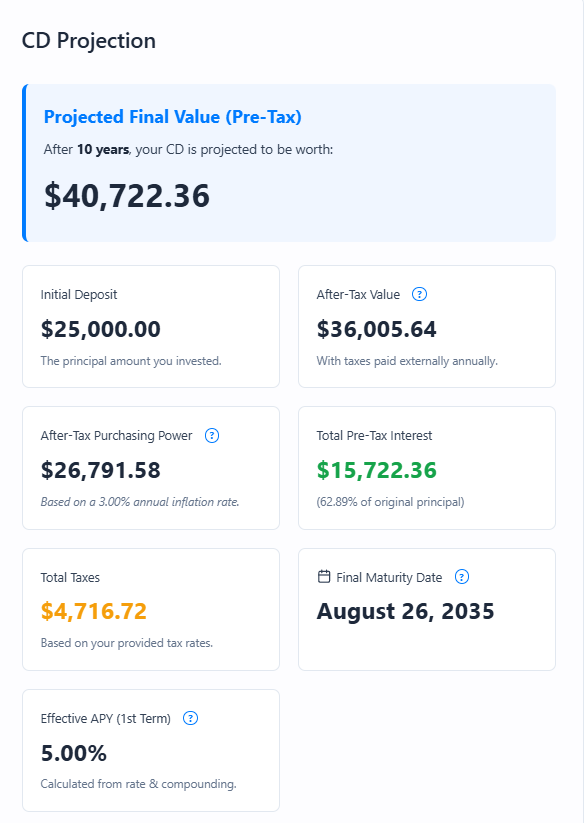
This example illustrates how a $25,000 deposit in a 2-year CD at 5% APY, rolled over for 10 years, grows to $36,005 after taxes. When adjusted for 3% annual inflation, the real value equals about $26,793 in today’s dollars.
Example 2: The Impact of an Early Withdrawal
A saver invests $50,000 into a 5-year CD at 5.25% APY. An emergency forces a withdrawal after 18 months. The bank’s penalty is 6 months of interest. They use the CD calculator with penalty to see the financial impact.
- Inputs: $50,000 deposit, 5-year term, 5.25% APY, withdrawal at 18 months, 6-month interest penalty.
- Results from the CD Calculator:
- Final Value After Penalty: $52,706.80
- Total Opportunity Cost: The calculator also shows that if held to maturity, the value would have been $64,577.39, revealing that the early withdrawal cost them nearly $11,870 in potential future earnings and penalties.
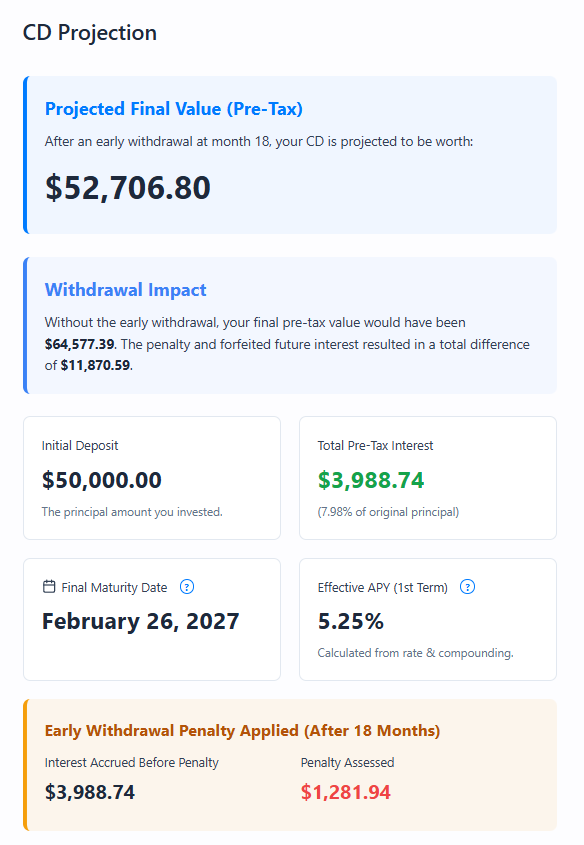
This example illustrates how an early withdrawal at 18 months on a 5-year CD with $50,000 deposit and 5.25% APY reduced the saver’s return to $52,706 after penalty, compared to $64,577 if held to maturity — a loss of nearly $11,871 in future earnings and penalties.
Example 3: Maximizing After-Tax Returns
An investor in a 32% tax bracket uses the CD calculator to compare two tax strategies for a $100,000 deposit in a 5-year CD earning 4.75% APY. When annual taxes on interest are deducted from the CD balance, the final after-tax value is $117,227.54. In contrast, if taxes are paid from an external account, allowing the CD to compound on the full amount, the balance grows to $117,758.87. This difference of over $500 illustrates how the method of handling taxes can influence long-term returns, even on the same investment.
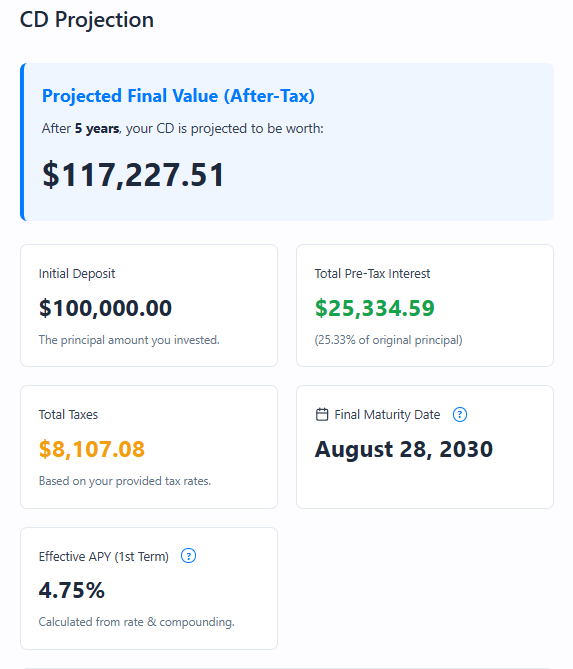
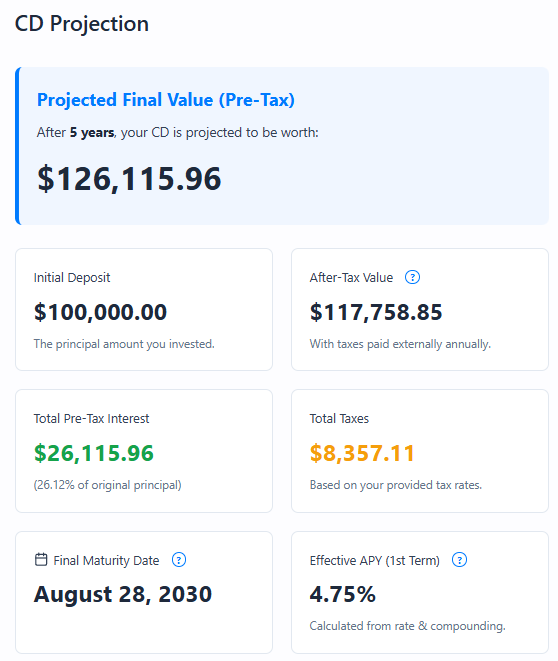
This example illustrates how different tax strategies can change the final value of the same CD investment.
Strategic Considerations for Maximizing Your CD Returns
Using a CD Calculator is the first step. The next is implementing strategies to ensure you’re getting the best possible returns.
- Shop for the Best Rates: Don’t just accept the rate offered by your primary bank. Online-only banks and credit unions typically offer significantly higher APYs due to their lower overhead. Use online comparison tools to find the best nationally available rates.
- Choose the Right Term for the Economic Environment: The decision to go long or short is strategic. If you believe interest rates are high and likely to fall, locking in a long-term CD (3-5 years) can be a smart move. If rates are low and expected to rise, you might prefer shorter terms or a bump-up CD to avoid being stuck with a low yield.
- Understand the Fine Print: Before you sign, always read the account disclosure. Pay close attention to the early withdrawal penalty calculation, the “grace period” after maturity (typically 7-10 days when you can withdraw penalty-free), and the bank’s policy on auto-renewal.
- Leverage a CD Ladder: As mentioned, a CD ladder is a powerful strategy. It mitigates interest rate risk by diversifying your money across multiple maturity dates, and it provides regular access to a portion of your funds, greatly increasing your liquidity.
Common Mistakes to Avoid with CDs and Calculators
- Forgetting the Grace Period: Many people forget about their CD’s maturity date. If you miss the grace period, many banks will automatically roll your entire balance into a new CD of the same term, but at whatever the current interest rate is, which could be much lower.
- Chasing the Highest APY Blindly: The highest rate isn’t always the best product. It might belong to a “callable CD,” which the bank can terminate if rates fall, robbing you of your high yield. Always understand the type of CD you are buying.
- Ignoring the Macro-Economic Environment: CD rates are heavily influenced by the Federal Reserve’s monetary policy. Paying attention to economic news can provide clues as to whether rates are likely to rise or fall, helping you make more strategic decisions about term lengths.
- Using a Simplistic Calculator: Relying on a calculator that doesn’t account for taxes, inflation, and penalties will give you a dangerously optimistic and inaccurate projection. Always use a comprehensive CD Calculator like this one for serious financial planning.
FAQs – CD Calculator
Learn More About CDs
If you’d like to explore further and get an in-depth understanding, here are some trusted references:
Related Tools on Our Site
Take Control of Your Savings Goals
Now that you have a deep understanding of how CDs work and the strategic insights available, use our CD Calculator to its full potential. Compare offers, model complex scenarios, and build a clear roadmap for your savings. Bookmark this page and share this powerful Certificate of Deposit Calculator with anyone looking to make smarter, data-driven financial decisions.
Conclusion
A Certificate of Deposit is a foundational tool for secure, predictable savings growth. However, to unlock its true potential, one must look beyond the advertised APY and analyze the variables that shape your net return. By meticulously accounting for taxes, penalties, reinvestment strategies, and the silent erosion of inflation, our comprehensive CD Calculator provides the unparalleled clarity required to make truly informed investment decisions. This CD Calculator elevates a simple savings product into a fully predictable and strategic component of your financial plan, empowering you to reach your goals with confidence and precision.
Disclaimer: This CD Calculator is provided for informational and illustrative purposes only and does not constitute financial advice. The results are estimates based on the inputs you provide. Always verify the specific terms and conditions of any financial product with the issuing institution and consult with a qualified financial professional before making any investment decisions.