
Fixed Deposit Calculator | FD Interest & Maturity Online | India
Calculate FD maturity, interest, and post-tax returns instantly with our Fixed Deposit Calculator. Simple, accurate, and perfect for planning savings in India.
Calculate your FD Returns
Enter details on the left to see maturity value.
Let’s be honest, for most of us in India, the Fixed Deposit (FD) is like that reliable old friend who might not be the most exciting person at the party, but is always there when you need them. Whether you are just starting your first job, saving for a wedding, or parking your retirement corpus, the FD is usually the first stop. It feels safe. It feels familiar. You put money in, and a few years later, you get more back.
But here is where things get a little tricky. While the concept is simple, the math often isn’t.
Have you ever walked into a bank, looked at a board saying “7.5% Interest,” and mentally calculated your returns, only to find the final maturity amount in your passbook looks different? That happens because of the “magic”—and sometimes the confusion—of compounding frequencies, TDS deductions, and fluctuating inflation rates.
You shouldn’t have to rely on rough guesswork or complex Excel sheets to figure out how much your money is actually growing. Planning your finances should be straightforward. That is exactly why having a reliable tool right in front of you matters. It bridges the gap between what you think you will earn and what actually lands in your bank account.
What This Fixed Deposit Calculator Helps You Do
This isn’t just a basic multiplier tool. If you look at the calculator above, you will see it’s designed to handle the messy reality of banking terms. Most simple calculators just take your principal and add interest. But real life involves taxes, inflation, and sometimes breaking an FD before it matures.
Here is what this tool helps you clarify:
- The “Real” Maturity Value: It calculates compound interest accurately based on whether your bank compounds quarterly, monthly, or yearly.
- Tax Planning: It doesn’t just show you gross profit. By entering your tax bracket, you can see your post-tax returns. This is crucial because a 7% FD might only be yielding 4.9% if you are in the 30% tax bracket.
- Inflation check: This is a feature many ignore. If your FD gives you 6% but inflation is 5%, your real growth is barely anything. This tool lets you visualize that.
- Premature Withdrawal Penalties: Life happens. Sometimes you need the money early. This tool lets you factor in the penalty to see how much you lose if you break the deposit early.
If you haven’t calculated your exact returns yet, scroll up and try your numbers now. It takes less than thirty seconds.
How to Use the Calculator (Step-by-Step)
Using this tool is intuitive, but let’s walk through the specific fields so you get the most accurate result possible. The more precise your input, the closer the result will be to your actual bank statement.
- Enter Deposit Details:
Start by typing in your Principal Amount. This is the lump sum you plan to invest. Next, set the Annual Interest Rate. You can use the slider for a quick view or type the exact percentage offered by your bank.
- Set the Tenure:
How long are you locking the money away for? You can mix and match years and months. For example, if your FD is for 1 year and 6 months, enter “1” in the Years field and “6” in the Months field.
- Choose Compounding Frequency:
This is the most important step for accuracy. Most Indian banks compound interest Quarterly (every 3 months). However, some corporate FDs might do it half-yearly or yearly. Select the one that applies to your scheme.
- Cumulative vs. Payout:
- Cumulative: Keep this checked if you want the interest to be reinvested and paid out at the end (Maturity).
- Unchecked (Payout Mode): Uncheck this if you want regular income (monthly or quarterly interest payouts) instead of a lump sum at the end.
- Refine with Advanced Options:
- Premature Withdrawal: If you think you might withdraw early, check this box. It will ask for the withdrawal month and the penalty percentage (usually 0.5% or 1%).
- Tax & Senior Citizen: Enter your tax slab (e.g., 20 or 30). If you toggle the Senior Citizen switch, the calculator automatically adds the standard 0.5% extra interest that banks usually offer seniors.
- Inflation: Use the slider to set expected inflation (standard is around 5-6%) to see the “real” value of your maturity amount.
- Click Calculate:
Hit the button to generate your summary, growth table, and charts.
The Formulas Behind the Math
For those who like to know what is happening under the hood, transparency is key. This tool doesn’t use magic; it uses standard financial formulas used by banking systems globally.
1. The Compound Interest Formula (Cumulative FDs)
When your interest earns interest, we use this formula to determine the Maturity Amount (A).
A = P × (1 + r/n)^(n × t)
- P: Principal amount (The money you put in).
- r: Annual interest rate (in decimal form, so 7% becomes 0.07).
- n: Number of times interest compounds per year (Quarterly = 4).
- t: Tenure in years.
- ^: Represents “to the power of”.
2. Simple Interest Formula (Non-Cumulative Payouts)
If you chose the “Payout” option where interest is sent to your savings account regularly, the formula changes because the interest is not reinvested.
Total Interest = P × r × t
3. Post-Tax Return
This determines what actually hits your pocket after the government takes its share (TDS or Income Tax).
Post-Tax Value = Principal + [ Total Interest × (1 – Tax Rate) ]
4. Real Rate of Return (Inflation Adjusted)
This formula calculates the purchasing power of your money in the future by accounting for inflation.
Real Return = Maturity Value / (1 + Inflation Rate)^t
Real Examples: Seeing the Numbers in Action
Let’s look at three realistic scenarios to see how different inputs change the outcome.
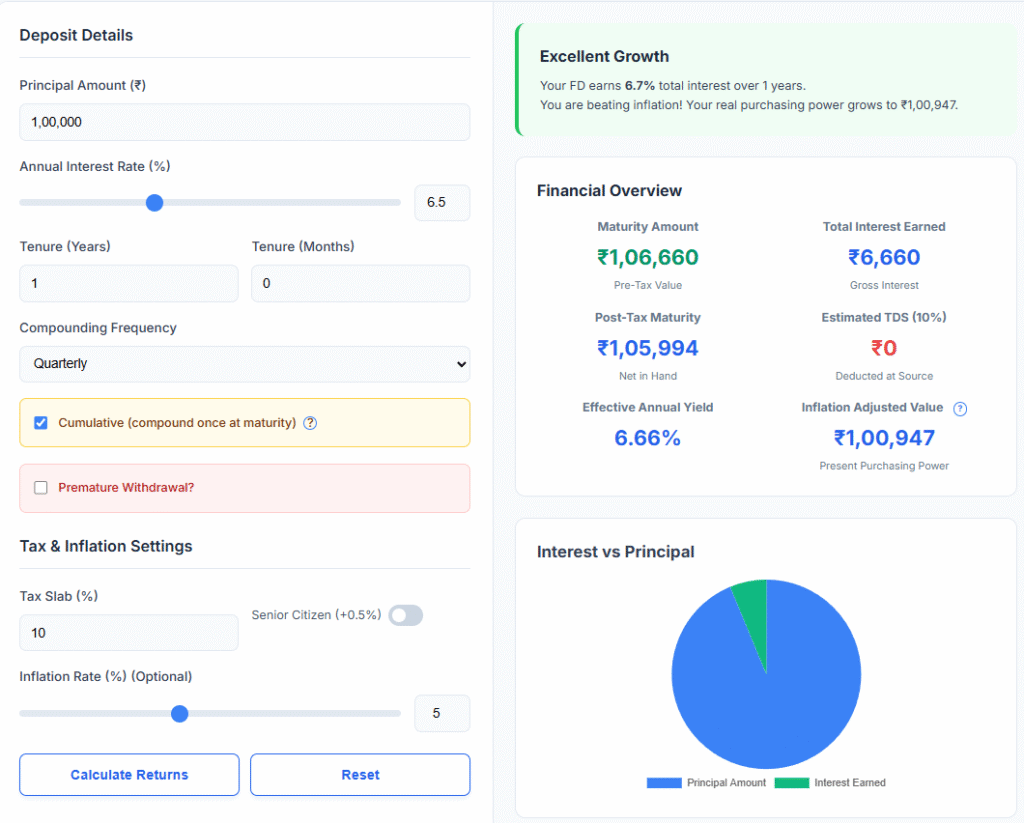
Example 1: Standard FD With Quarterly Compounding
Type: Cumulative FD (Interest is reinvested and paid at maturity)
A saver invests ₹1,00,000 for 1 year at an annual interest rate of 6.5%. The bank adds interest every quarter (every 3 months).
Inputs
- Principal: ₹1,00,000
- Rate: 6.5%
- Tenure: 1 Year
- Compounding Frequency: Quarterly
- Tax Rate: 10% (TDS)
Breakdown: Because interest is compounded quarterly, you earn interest on your interest. While the base rate is 6.5%, the compounding effect slightly increases the total earnings.
Final Results
- Maturity Amount (Pre-Tax): ₹1,06,660
- Total Interest Earned: ₹6,660
- Tax Deduction (10%): (-) ₹666
Net Amount Received:₹1,05,994
Example 2: Monthly Payout FD
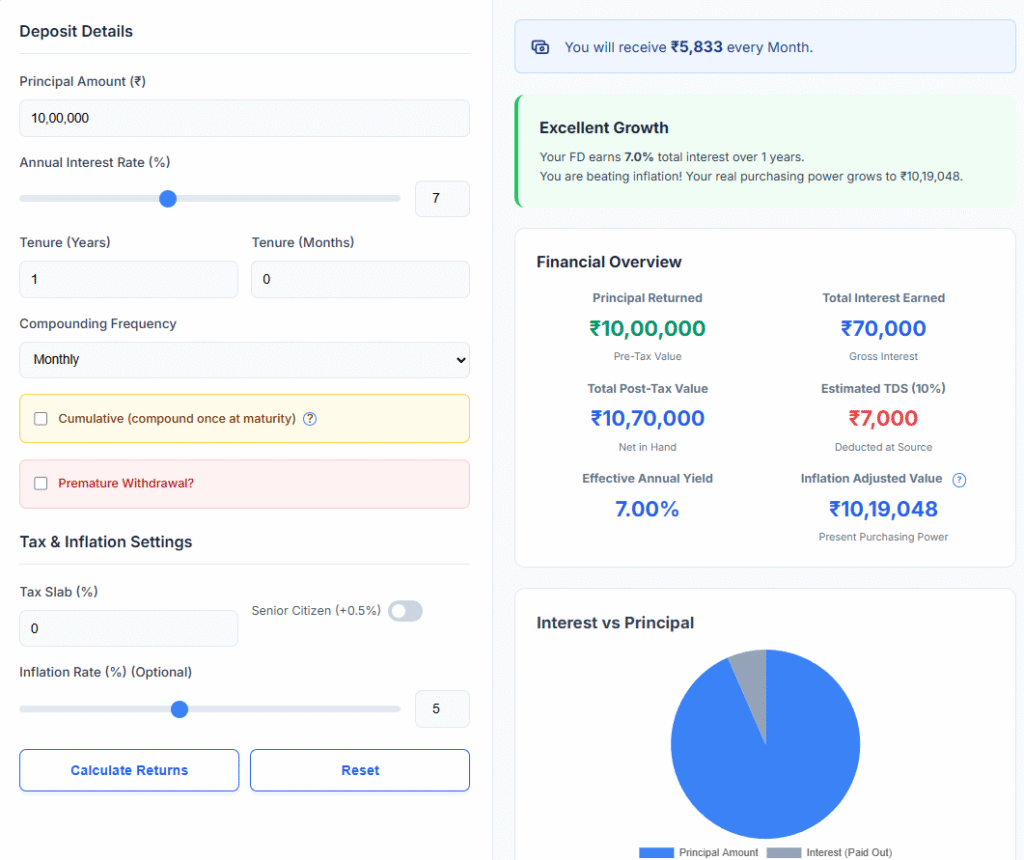
Type: Non-Cumulative FD (Interest is NOT reinvested; it is paid to your bank account monthly)
A depositor invests ₹10,00,000 for 1 year at 7% annual interest and chooses the monthly payout option to help with regular expenses.
Inputs
- Principal: ₹10,00,000
- Rate: 7%
- Payout Frequency: Monthly
- Tax: 0% (Assumed below taxable limit)
Breakdown In a non-cumulative payout scheme, the bank calculates the annual interest and divides it by 12. This amount is sent to the depositor every month, and the original principal remains untouched until the end of the year.
Final Results
- Monthly Payout Amount: ₹5,833
- Total Interest Received (over 12 months): ₹70,000
- Principal Returned at Maturity: ₹10,00,000
Example 3: FD Broken Before Maturity (Premature Withdrawal)
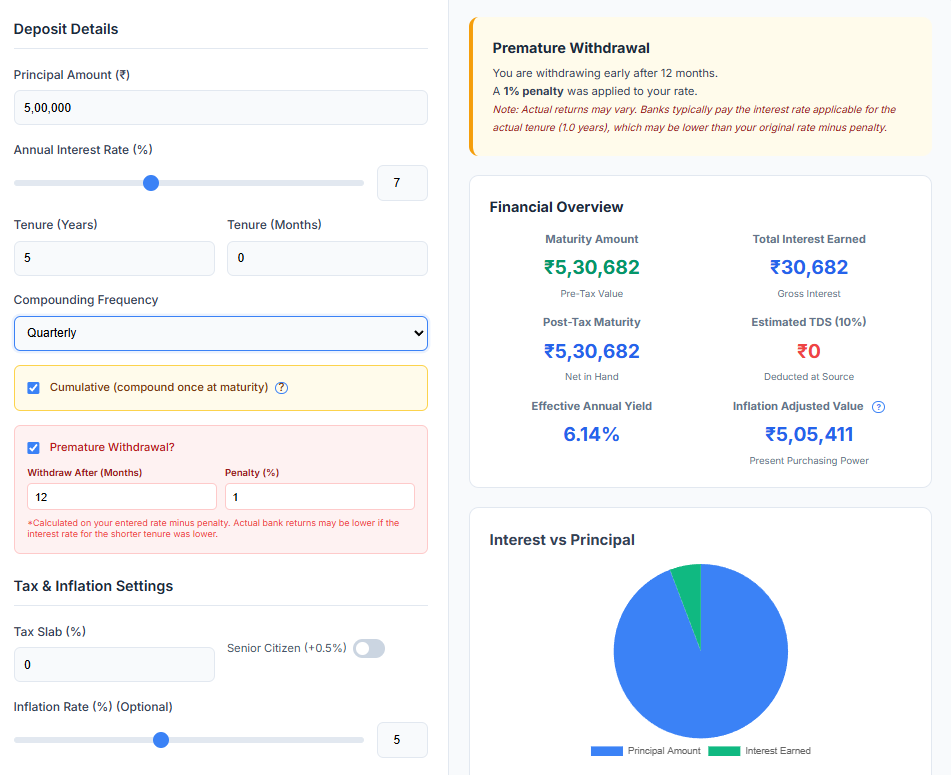
Type: Cumulative FD (Original plan was 5 years, but closed early)
A ₹5,00,000 FD was opened with a 5-year plan at 7%. However, the depositor had to close it after just 1 year. The bank charges a 1% penalty on the interest rate.
Inputs
- Principal: ₹5,00,000
- Original Rate: 7%
- Penalty: 1%
- Effective Rate: 6% (7% minus 1% penalty)
- Actual Tenure: 1 Year (12 Months)
- Payout Frequency: Quarterly
Breakdown Since the FD ran for only 1 year, the bank calculates interest for that specific year using the penalised rate of 6%. The calculation assumes standard quarterly compounding for that year.
Final Results
- Interest Rate Applied: 6%
- Interest Earned: ₹30,682
- Total Amount Refunded: ₹5,30,682
(Note: Even with the penalty, you earned ₹682 more than simple interest because of the quarterly compounding effect during that one year.)
Benefits of Using an FD Calculator Online
You might wonder, “Can’t I just ask the bank manager?” You can, but bank representatives often quote the “Yield” rather than the actual interest rate, or they might not account for tax deductions (TDS) in their verbal pitch. Using a digital tool puts the power back in your hands.
1. Instant Comparison:
You can open tabs for three different banks—SBI, HDFC, and ICICI—and plug their rates into the calculator. You will immediately see which one gives you better returns over a 5-year period.
2. Accuracy over Estimates:
Mental math usually ignores compounding. We tend to think $1 \ lakh \times 7\% = 7,000$. But with quarterly compounding, it’s actually ₹7,186. Over large amounts and long years, that difference runs into thousands of rupees.
3. Planning for Goals:
If you know you need exactly ₹5 Lakhs for a down payment in 3 years, you can play around with the “Principal Amount” field until you find the exact deposit size required to reach that goal.
4. Visualizing Tax Pain:
Seeing the difference between “Pre-Tax Maturity” and “Post-Tax Maturity” is often a wake-up call. It encourages you to look for tax-saving FDs (5-year lock-in) or explore other instruments if the tax bite is too high.
Scroll up and check your numbers again—are you beating inflation?
When FD Calculators Can Be Misleading
While calculators are incredibly useful, they are mathematical models. They assume the world is perfect, and we know it isn’t. There are a few scenarios where the number on the screen might differ slightly from reality.
1. The TDS Threshold:
Calculators often estimate TDS at a flat 10%. However, if you have not submitted your PAN card, the bank might deduct 20%. Conversely, if you submit Form 15G/15H, no TDS is deducted. The calculator shows you the standard deduction, but your actual tax liability depends on your total income.
2. Changing Interest Rates:
This tool assumes the interest rate remains constant for the entire tenure. While this is true for standard Fixed Deposits, some “Floating Rate” FDs change their returns based on RBI repo rates. This calculator is built for standard fixed-rate deposits.
3. Compounding Frequency Variations:
Most calculators assume quarterly compounding because that is the standard in India. However, according to resources like Investopedia, compounding frequency can significantly impact long-term returns; if a specific scheme compounds daily or monthly, the yield will be slightly higher than what a standard quarterly calculator shows. Always check the fine print of your specific bank scheme.
Fixed Deposit Calculator FAQs
Explore Other Financial Calculators
While the Fixed Deposit is a great starting point, a balanced financial portfolio usually involves a mix of instruments. Once you have analyzed your FD returns, you might want to explore:
- SIP Calculator: If you are looking for potentially higher returns (with higher risk) via Mutual Funds.
- Recurring Deposit (RD) Calculator: Ideally suited for those who want to save small amounts monthly rather than a lump sum.
- Compound Interest Calculator: To see how compounding works on general investments, not just bank deposits.
- PPF Calculator: For long-term, tax-free government savings schemes.
Conclusion
Managing money doesn’t have to be intimidating. The days of waiting for a passbook update to know your balance are long gone. Tools like this Fixed Deposit Calculator put you in the driver’s seat of your financial journey.
Whether you are trying to beat inflation, looking for a safe place to park your bonus, or planning a monthly income stream for your parents, running the numbers first is the smartest move you can make. It turns vague hopes into concrete plans.
So, go ahead. Scroll back up, play with the sliders, adjust the tenure, and see exactly what your money can do for you. After all, it’s your hard-earned money—you deserve to know exactly how hard it is working for you.