
UPS Calculator | Unified Pension Scheme Calculator + UPS vs NPS Calculator Comparison | India
Use our UPS Calculator to estimate your Unified Pension Scheme (UPS) pension, maturity value, IC vs BC ratio, and monthly payout. Instantly compare UPS vs NPS to see which gives better returns and benefits. Designed as per the latest pension rules for government employees in India.
Your results will appear here
Fill in your details and click calculate.
Making a secure retirement plan is the most important financial decision for any government employee. The introduction of the Unified Pension Scheme (UPS) by the Government of India has created a critical new choice. This guide is built to be your most trusted resource for understanding this new scheme. Based on the official Gazette Notification (F. No. FX-1/3/2024-PR) dated January 24, 2025, this article provides a complete breakdown of the rules, expert checked examples, and a powerful ups calculator to help you decide: Is the new “assured” UPS right for you, or is the standard market linked NPS a better fit?
This page provides a step-by-step ups vs nps calculator and a detailed guide to help you compare your options accurately.
What You’ll Find on This Page
This guide, combined with our powerful ups calculator, will help you:
- Understand the Unified Pension Scheme (UPS): We’ll break down the official rules—who is covered, how much you contribute, and what “assured pension” really means, including the critical disability and family pension rules.
- Learn to Use the ups calculator: A detailed, step-by-step walkthrough of every input field so you can get an accurate projection.
- See Realistic Worked Examples: We’ll run several real-life scenarios through the ups vs nps calculator to show how different careers (including high-salary) and choices affect the outcome.
- Compare UPS vs. NPS: An honest, in-depth comparison of contributions, returns, risks, and final pension payouts, including a side-by-side table and a “who should choose” guide.
- Get Answers: An expanded, comprehensive FAQ section to answer your most pressing questions about the UPS pension and our calculator.
What is the Unified Pension Scheme (UPS)?
The Unified Pension Scheme (UPS) is a new pension option for Central Government employees covered under the NPS. It was introduced via the official Gazette Notification on January 24, 2025, with an effective date of April 1, 2025.
It is a hybrid “target benefit” model. Unlike the pure market-driven NPS, the UPS provides a defined benefit-like pension, but its final payout is still linked to the performance of a fund. Its purpose is to offer a pension that is more stable and protected from inflation than the standard NPS annuity.
Who is Eligible?
The “Assured Payout” (pension) under UPS is available if you exit in one of the following ways:
- Superannuation: You retire at your standard retirement age after at least 10 years of qualifying service.
- Voluntary Retirement: You take voluntary retirement after at least 25 years of qualifying service.
- FR 56(j) Retirement: The government retires you under these provisions (which is not a penalty).
Important: You are NOT eligible for the UPS assured pension if you are removed, dismissed, or resign from service. In those cases, the UPS option does not apply, and you will be treated under standard NPS exit rules.
How Contributions Work
When you opt for UPS, your contribution structure changes:
- Standard NPS (for comparison): 10% (Employee) + 14% (Government) = 24% total into your NPS account.
- Unified Pension Scheme (UPS):
- 10% (Employee): This is the mandatory employee contribution.
- 10% (Government): This 10% matching contribution goes into your “Individual Corpus” (IC).
- Additional Govt. Contribution: The government contributes an additional amount to a separate “Pool Corpus”. This pool is managed by the government and is used to help fund the “assured” part of the pension scheme. The Gazette does not specify a fixed percentage; it states this will be an additional contribution to support the assured payouts.
- Voluntary Contributions: As this is part of the NPS framework, you can still make voluntary contributions to your Tier-I account (which would grow within your IC) or to a Tier-II account.
The “Assured Payout” (Your Pension)
This is the main promise of the UPS.
- Full Pension: If you have 25 or more years of qualifying service, your assured pension is 50% of your 12-monthly average basic pay just before retirement.
- Pro-rata Pension: If you have more than 10 but less than 25 years of service, your pension is paid proportionately. The formula is essentially:
(50% of Avg. Basic Pay) x (Your Months of Service / 300 Months)
- Minimum Pension: There is a guaranteed minimum pension of ₹10,000 per month (plus DR) if you have at least 10 years of service.
Critical: Disability Pension Rules
The UPS provides specific, stronger protections for disability. If an employee retires on account of any disability, they are entitled to a UPS disability pension equal to the full Assured Pension (50% of average basic pay).
Crucially, the IC/BC adjustment does not apply in this case. The full assured pension is paid regardless of your corpus performance.
Critical: Death-in-Service Benefits (Family Pension)
The rules for family pension in case of death-in-service are also clearly defined and offer significant protection:
- Pension Amount: The family is entitled to a family pension equal to 60% of the employee’s assured pension.
- IC/BC Irrelevant: The Benchmark Corpus (BC) is irrelevant for family pension. The family receives 60% of the full assured pension the employee would have been entitled to, even if the employee’s IC was performing poorly.
- Dearness Relief (DR): The family pension also continues to receive Dearness Relief, protecting its value over time.
- Lump Sum: The rules for the UPS lump sum benefit also apply to the nominee in case of death-in-service.
The Single Biggest Advantage: Dearness Relief (DR)
This is what truly sets the UPS apart from the NPS.
- UPS Pension: Your assured pension (and family pension) is eligible for Dearness Relief (DR). This means your pension will increase over time, just as a serving employee’s salary does. This protects your purchasing power from inflation.
- NPS Pension: The standard pension (annuity) you buy from your NPS corpus is fixed for life. It does not increase with inflation, meaning its real value decreases every year. (Note: Some “increasing annuity” options exist, but they start at a much lower initial pension).
The UPS Lump-Sum Benefit
This is a UPS-specific benefit calculated strictly through the Gazette formula. This lump sum is not gratuity, which is a separate benefit calculated under its own rules.
Definition: Emoluments for Lump Sum
For the purpose of this calculation, “Emoluments” = Last Basic Pay + Dearness Allowance (DA).
- Formula: Lump sum = 10% of last emoluments (Basic + DA) × every completed 6-month period of qualifying service.
- Eligibility: This lump sum has its own rule. It is available only if: (a) you are retiring on superannuation, (b) you have ≥ 25 years of service (e.g., in a voluntary retirement), or (c) you are retired under FR 56(j). The 10-year minimum service rule applies to pension eligibility, but the lump sum has this different, stricter rule.
How UPS Pension is Calculated: The IC/BC Catch
This is the most important section to understand. Your “Assured Pension” is not guaranteed at 50% automatically. It is subject to a pro-rata calculation based on your fund’s performance.
The Gazette notification introduces two key concepts: your Individual Corpus (IC) and a Benchmark Corpus (BC).
- Individual Corpus (IC): This is your money. It’s the 20% (10% Employee + 10% Govt) contribution that accumulates in your name. Its final value depends on your actual investment choices.
- Benchmark Corpus (BC): This is a regulatory benchmark, not a performance expectation. It is a target value calculated by PFRDA.
How is the Benchmark Corpus (BC) Calculated?
You won’t see an official BC on your statement during your employment. The official BC is only computed at the time of exit by the Authority (PFRDA).
It is calculated using a model portfolio based on:
- Your entire contribution history and service length.
- Historical DA hikes.
- Government-notified return assumptions for the ‘default’ investment pattern.
- It is a calculation based on this history, not the daily NAV of a live fund.
The ups calculator on this page creates an approximation of the BC to help you model scenarios.
The Final UPS Pension Formula
Under the UPS, the Benchmark Corpus (BC) is always calculated, even if the employee has no missing credits and made no partial withdrawals. It is the official reference target against which your own performance is measured.
At retirement, PFRDA will compare your IC to your BC. Your actual pension is paid based on this formula:
UPS Pension = Assured Pension × (Your IC Value ÷ Your BC Value)
Let’s look at the three possible scenarios:
- Ideal Scenario (IC ≈ BC): If there are no withdrawals and no missing credits, BC is still only an official reference target. IC = BC exactly is not guaranteed. Your IC may still be higher or lower due to fund choice, NAV movements, contribution timing, and earlier portfolio performance. If your IC is equal to or greater than the BC, you get your full 100% (or pro-rata) assured pension.
- Good Scenario (IC > BC): You were a great investor and your IC is more than the BC. You will get 100% of your assured pension. The extra amount, (IC − BC), is refunded to you as a lump sum. This excess amount does not increase your pension; it is a one-time refund paid out at retirement, and its details will appear in your pension order.
- Bad Scenario (IC < BC): Your IC is less than the target BC. Your pension will be proportionately reduced. If your IC is only 90% of the BC, you will only receive 90% of your assured pension.
What are “Missing Credits”?
“Missing Credits” are gaps in your contribution record. This is a common issue and can seriously impact your pension.
- What counts as missing: A month where your 10% contribution (and the matching 10% government share) was not deposited into your NPS Tier-I account.
- Common causes: Delays in processing during your initial joining, periods of leave without pay, or administrative errors during a transfer.
- How it affects IC: Your Individual Corpus (IC) is lower because that month’s contribution and all its future compounding growth are missing.
- How it impacts BC: The Benchmark Corpus (BC) calculation assumes a perfect contribution record.
- How to fix it: It is crucial to check your NPS statement annually. If you find missing credits, you must contact your DDO/PAO to get them rectified and the missing contributions (plus interest) deposited.
How to Use the UPS Calculator or ups vs nps calculator (Step-by-Step Guide)
Our comprehensive ups calculator (which you see on this page) is designed to handle all these complex rules. It projects your IC and BC, compares them, and then runs the full NPS calculation side-by-side.
Here is a step-by-step guide to every field.
Section 1: Employee & Exit Details
- Type of Exit: This is the most important input. Select “Superannuation,” “Voluntary Retirement,” or “Resignation.”
- Calculation As Of Date: Pre-filled to today’s date. This is the starting point for all projections.
- Date of Birth (DOB): Your birth date. Used to calculate your age and superannuation date.
- Date of Joining Service (DOJ): The date you joined government service. This is used to calculate your total qualifying service.
- Retirement Age (Years): (Appears for Superannuation). Enter your official retirement age (e.g., 58, 60, 62).
- Date of Leaving Service (DOL): (Appears for Premature Exit). Enter the date you plan to resign or take voluntary retirement.
Section 2: Salary & Financial Assumptions
- Current Basic Pay (₹): Enter your current monthly basic pay.
- Current DA Rate (%): Enter the Dearness Allowance rate as a percentage (e.g., 50%).
- Current NPS Corpus (₹): Enter the total current value of your NPS Tier-I account. The ups calculator will use this as the starting point and project its growth until your retirement.
- Past Withdrawals (Not Recouped) (₹): CRITICAL INPUT. If you have made partial withdrawals from your Tier-I NPS fund and not repaid them, enter the amount here. This amount will be subtracted from your final IC, increasing your risk of a pro-rata pension cut.
- Missing Credits Adjustment (₹): CRITICAL INPUT. If you have known gaps in your contribution history, enter the estimated value here. This also reduces your final IC.
- Estimate Benchmark Corpus (if unknown):
- Check this box (Default): This is the easiest option. The ups calculator will run its own projection assuming the PFRDA ‘default’ investment return to create an estimated BC.
- Uncheck this box: If you have an official NPS statement that tells you your “Official Benchmark Corpus (BC),” uncheck this box and enter the value in the field that appears.
- Annual Basic Pay Growth (%): Enter your expected average annual increment (e.g., 3% for the annual increment).
- Biannual Dearness Allowance Hikes (%): Enter the percentage-point increase you expect twice a year (e.g., ‘4’ for a 4% hike), not a percentage of the old DA.
- Estimated NPS Returns (%): CRITICAL INPUT. This is the return you expect to earn on your investments (your IC in UPS, or your full corpus in NPS). This rate directly competes against the “default” fund return that determines the BC.
- Annuity Rate under NPS (%): The interest rate you expect to receive from an annuity provider when you retire. This is used only for the NPS pension calculation. 6% is a common, conservative estimate.
Section 3: Pay Commission Hikes (Optional)
- Enable Pay Commission: Check this to model large, periodic salary jumps. (Note: Pay progressions are only illustrative; UPS does not guarantee future Pay Commission outcomes.)
UPS Maturity Amount vs. UPS Pension
A common point of confusion is the difference between your “maturity amount” and your “pension.” They are not the same.
- UPS Pension: This is the monthly payment you receive for life after you retire. It is calculated based on your average pay, qualifying service, and fund performance. The full formula as per the Gazette is:
(50% of Avg. Basic Pay) x (Qualifying Service in Months / 300) x (IC / BC Ratio)
This final pension amount then increases with Dearness Relief (DR) and is your primary retirement income.
- UPS Maturity Amount: This is the total one-time, lump-sum cash you receive at retirement. It is a combination of two separate things:
- The UPS Lump-Sum Benefit: (10% of last emoluments × 6-month periods). This is available on superannuation, or ≥ 25 years of service, or FR56(j).
- The Excess Corpus Refund: (Your IC − Your BC), if your IC is greater than your BC.
Therefore, your total retirement benefit from UPS is the UPS Pension (a lifelong, increasing income) + the UPS Maturity Amount (a one-time payout). This ups calculator estimates all of these for you.
What Affects Your Final UPS Pension?
Your final monthly pension is not fixed. It depends on several factors that you can track throughout your career.
- Your Service Length: This is the most important factor. Less than 25 years of service results in a pro-rata (proportionately lower) pension.
- Your Average Basic Pay: Your pension is 50% of your average basic pay in your last 12 months. Higher promotions mean a higher pension.
- Your Investment Returns (IC): The performance of your 20% Individual Corpus. Higher returns increase your IC.
- Partial Withdrawals: This is the biggest negative. Any Tier-I withdrawal you don’t repay directly reduces your IC, which can lead to a permanent cut in your pension.
- Missing Credits: Gaps in your contribution history also lower your IC and can lead to a pension cut.
The BC Performance: The “target” BC is based on the default fund’s return. Your IC must keep pace with this benchmark.
Calculate Your UPS Pension Now You’ve seen the inputs. Now, it’s time to get your personalized numbers. Take a moment to fill in your details in the ups calculator above. Once you have your results, the following examples will help you understand them better.
UPS Pension Amount Calculation: Worked Examples
Let’s run five common scenarios through the ups vs nps calculator.
Common Assumptions:
- Calculation Date: 01 November 2025
- Pay Commission: 8th PC in Jan 2026 (1.85x Multiplier, DA resets to 0%).
- Salary Growth: 3% Annual Increment (July).
- DA Growth: 4% Biannual (Jan/July).
- NPS Annuity Rate: 6%.
Example 1: Mid-Career Employee (Standard)
A typical employee retiring at 58 with full qualifying service.
Profile & Inputs:
- Exit Type: Superannuation
- Date of Birth: 01 July 1985
- Date of Joining Service: 01 January 2013
- Current Basic Pay: ₹ 85,000
- Current DA Rate: 53%
- Current NPS Corpus: ₹ 30,00,000
- NPS Return: 9%
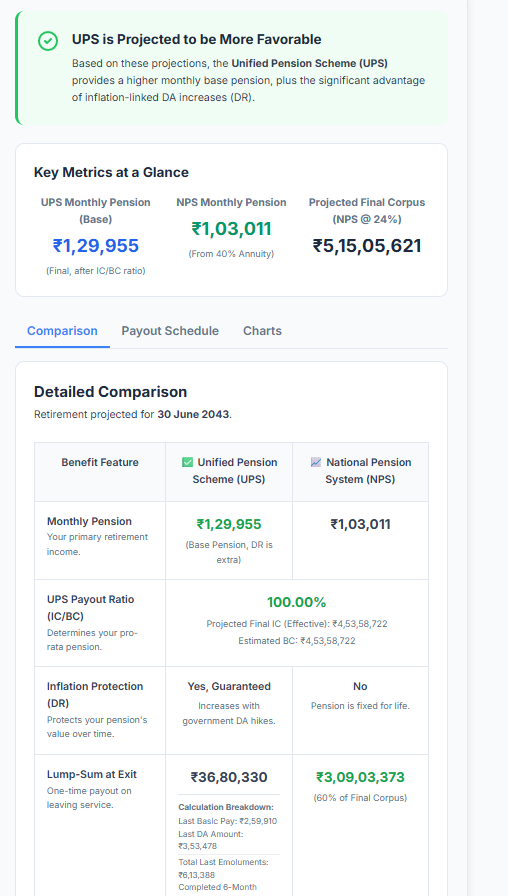
Projected Results (Exit Date: 30 June 2043)
- Qualifying Service: 30 Years, 5 Months
1. Unified Pension Scheme (UPS)
- Last Basic Pay (Projected): ₹ 2,59,910
- Monthly Pension (Base): ₹ 1,29,955 + DR
- (50% of Avg. Basic ₹ 2,59,910)
- Lump Sum (Gratuity-like): ₹ 36,80,330 (~₹ 36.8 Lakhs)
- (10% × Last Emoluments × 60 Six-Month Periods)
2. National Pension System (NPS)
- Total Corpus: ₹ 5,15,05,621 (~₹ 5.15 Crore)
- Monthly Pension (Fixed): ₹ 1,03,011
- Lump Sum (60%): ₹ 3,09,03,373 (~₹ 3.09 Crore)
Analysis: The numbers clearly show the contrasting nature of UPS and NPS at retirement. Under the Unified Pension Scheme, the employee secures a stable, inflation-indexed lifelong pension, starting at ₹1.29 lakh per month. This amount is not only higher than the NPS annuity by about ₹27,000, but it will also continue to grow through Dearness Relief (DR), providing long-term protection against rising living costs.
On the other hand, NPS builds significantly more wealth, thanks to continuous compounding of contributions and investment returns. By age 58, the employee accumulates a corpus worth ₹5.15 crore, from which ₹3.09 crore can be withdrawn tax-free as lump sum. However, the NPS pension remains fixed at ₹1.03 lakh per month (based on 40% annuitization at 6%), and does not increase with inflation.
Overall, UPS offers a superior monthly pension with inflation protection, ideal for individuals prioritizing income stability and predictable post-retirement cash flow. In contrast, NPS offers substantial wealth creation and a large upfront lump sum, suitable for individuals who value flexibility and market-linked growth. The optimal choice depends on whether the employee prefers steady, guaranteed lifetime income (UPS) or greater financial autonomy and corpus size (NPS).
Example 2: Past Withdrawal (Penalty Scenario)
An employee who joined later (2008) with a smaller corpus and withdrew money that wasn’t returned.
Profile & Inputs:
- Exit Type: Superannuation
- Date of Birth: 15 May 1977
- Date of Joining Service:01 August 2008
- Retirement Age: 60 (Exit: 31 May 2037)
- Current Basic Pay: ₹ 1,20,000
- Current DA Rate: 53%
- Current NPS Corpus: ₹ 30,00,000
- Past Withdrawal (Unpaid): ₹ 5,00,000
- NPS Return: 9%
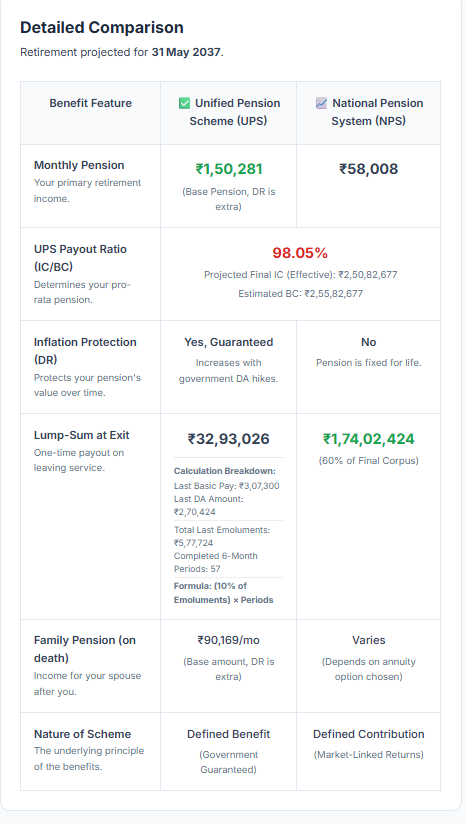
Projected Results (Exit Date: 31 May 2037)
- Qualifying Service: 28 Years, 9 Months
1. Unified Pension Scheme (UPS)
- Projected Full Pension: ₹ 1,50,281
- Penalty Ratio (IC/BC):98.05%
- (The ₹5L withdrawal is a larger chunk of this smaller corpus, slightly increasing the penalty)
- Final Monthly Pension: ₹ 1,50,281 + DR
- Lump Sum: ₹ 32,93,026 (~₹ 32.9 Lakhs)
2. National Pension System (NPS)
- Total Corpus: ₹ 2,90,04,040 (~₹ 2.90 Crore)
- Monthly Pension (Fixed): ₹ 58,008
- Lump Sum (60%): ₹ 1,74,02,424 (~₹ 1.74 Crore)
Analysis: Despite a long service period of nearly 29 years, the employee’s retirement picture shifts significantly due to two factors:
(1) A smaller starting NPS corpus and
(2) A past withdrawal of ₹5 lakh that was never restored, which directly reduces the Benchmark Corpus (BC) ratio under UPS.
Under the Unified Pension Scheme, the penalty is mild because the deduction is applied only to the IC/BC payout ratio. A ₹5 lakh withdrawal in a relatively smaller corpus translates to an IC/BC of about 98%, meaning only a minor pension reduction. Since UPS primarily depends on final pay rather than market performance, the employee still secures a strong monthly pension of ₹1.50 lakh (plus DR), ensuring dependable inflation-protected income for life.
On the other hand, the same withdrawal has a much sharper impact under NPS. The reduced starting corpus compounds more slowly, resulting in a significantly smaller retirement pot of ₹2.90 crore. This directly lowers the NPS annuity to ₹58,008 per month, which is nearly 62% lower than the UPS pension. This example clearly illustrates how even a single past withdrawal can meaningfully affect NPS outcomes, especially for employees who couldn’t accumulate aggressively during their early career years. For such individuals, the salary-linked, market-independent UPS formula offers far greater retirement stability and predictability.
Example 3: Late Joiner / Short Service
A specialist (e.g., Medical Officer) joining at age 45 and retiring at 65.
Profile & Inputs:
- Exit Type: Superannuation
- Date of Birth: 20 October 1970
- Date of Joining Service: 01 October 2015
- Current Basic Pay: ₹ 80,000
- Current DA Rate: 53%
- Current NPS Corpus: ₹ 25,00,000
- NPS Return: 9%
Projected Results (Exit Date: 31 October 2035)
- Qualifying Service: 20 Years, 0 Months
1. Unified Pension Scheme (UPS)
- Pro-rata Factor: 80% (20 years service / 25 years required).
- Monthly Pension (Base): ₹ 78,015 + DR
- Lump Sum (20 yrs): ₹ 14,00,253 (~₹ 14.0 Lakhs)
2. National Pension System (NPS)
- Total Corpus: ₹ 1,64,36,340 (~₹ 1.64 Crore)
- Monthly Pension (Fixed): ₹ 32,873
- Lump Sum (60%): ₹ 98,61,804 (~₹ 98.6 Lakhs)
Analysis: This scenario clearly highlights how UPS protects employees who join government service later in life. With only 20 years of qualifying service, the UPS pension is pro-rated to 80%, yet it still delivers a strong, salary-linked payout of ₹78,015 per month (plus DR). Because UPS depends primarily on the final average basic pay rather than accumulated corpus, late joiners receive a predictable and stable pension, even without decades of compounding.
In contrast, NPS struggles in short-service cases. Starting with a modest corpus of ₹25 lakh and having only about 10 years left until retirement, the investment horizon is too small to build a sufficiently large fund. As a result, the total NPS corpus reaches only ₹1.64 crore, generating a fixed annuity of ₹32,873 per month, which is less than half of the UPS pension.
This example demonstrates that UPS is particularly advantageous for late joiners, specialists, or medical officers who enter service mid-career. The defined, salary-based UPS pension overwhelmingly outperforms NPS for anyone with limited contribution years.

Example 4: High Performer (Excess Corpus Refund)
An investor whose NPS returns (11%) outperformed the government default benchmark (9%).
Profile & Inputs:
- Exit Type: Superannuation
- Date of Birth: 10 March 1975
- Date of Joining Service: 15 March 2010
- Retirement Age: 60
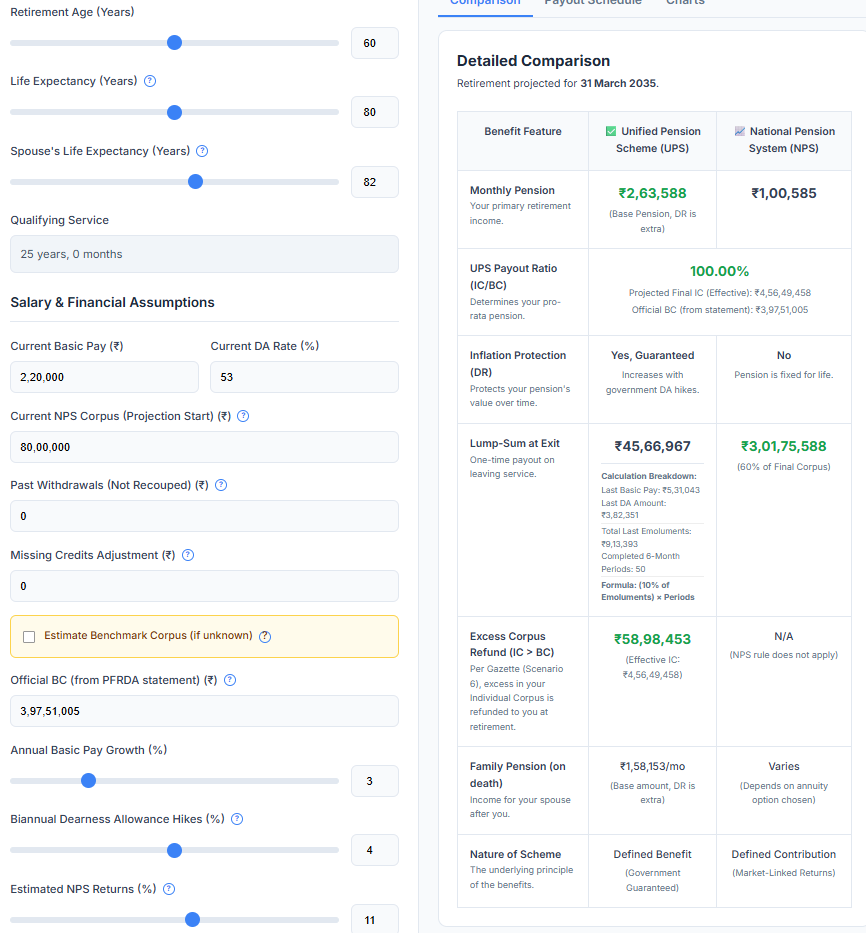
- Current Basic Pay: ₹ 2,20,000
- Current DA Rate: 53%
- Current NPS Corpus: ₹ 80,00,000
- NPS Return: 11% (High Performance)
Critical Calculator Settings:
- Estimate Benchmark Corpus (Checkbox):Unchecked ❌
- Official BC (Input Value): ₹ 3,97,51,005 (approx 3.98 Cr)
- Note: This value represents the “Benchmark” corpus growing at the default 9% rate. Enter this exact figure to trigger the comparison.
Projected Results (Exit Date: 31 March 2035)
- Qualifying Service: 25 Years, 0 Months
1. Unified Pension Scheme (UPS)
- Monthly Pension (Full): ₹ 2,63,588 + DR
- (50% of Avg. Basic ₹ 5,27,176)
- Lump Sum: ₹ 45,66,967 (~₹ 45.7 Lakhs)
- (10% × Last Emoluments × 50 Six-Month Periods)
- Excess Refund (Cash): ₹ 58,98,453 (~₹ 59.0 Lakhs)
- (Refunded because your projected IC of ₹ 4.56 Cr is higher than the Official BC of ₹ 3.98 Cr)
2. National Pension System (NPS)
- Total Corpus: ₹ 5,02,92,647 (~₹ 5.03 Crore)
- Monthly Pension (Fixed): ₹ 1,00,585
- Lump Sum (60%): ₹ 3,01,75,588 (~₹ 3.02 Crore)
Analysis: This example highlights the unique advantage of UPS for employees whose investment performance exceeds the government benchmark. With an impressive 11% NPS return, the employee’s Individual Corpus (IC) grows to ₹4.56 crore, surpassing the Official Benchmark Corpus (BC) of ₹3.98 crore. Because the “Estimate BC” option is unchecked, the system compares the IC directly with the manually entered BC — triggering the Excess Corpus Refund rule under Gazette Scenario 6.
As a result, the employee secures the full UPS pension of ₹2.63 lakh per month (plus DR), based entirely on the projected average basic pay. This amount is more than 160% higher than the NPS annuity of ₹1,00,585, providing significantly stronger monthly income security. On top of that, the employee receives an immediate cash refund of approximately ₹59 lakh, representing the surplus IC above the benchmark requirement. This refund is paid in addition to the regular UPS lump sum of ₹45.7 lakh.
Meanwhile, NPS continues to offer a sizeable retirement corpus of ₹5.03 crore thanks to market-linked growth. However, the fixed annuity remains much smaller and does not increase with inflation.
This scenario clearly shows why UPS becomes extraordinarily rewarding for high performers: it delivers maximum pension + inflation protection + a cash bonus for outperforming the benchmark — a rare combination of guaranteed income and reward for strong investment discipline.
Verdict: UPS is overwhelmingly superior here, offering both higher security and a payout for your investment performance.
Example 5: Worst-Case Scenario (Low Returns + Withdrawal)
An employee with poor investment choices (7.5%) and a significant un-returned withdrawal.
Profile & Inputs:
- Exit Type: Superannuation
- Date of Birth: 05 September 1977
- Date of Joining Service: 01 July 2007
- Retirement Age: 60
- Current Basic Pay: ₹ 1,20,000
- Current DA Rate: 53%
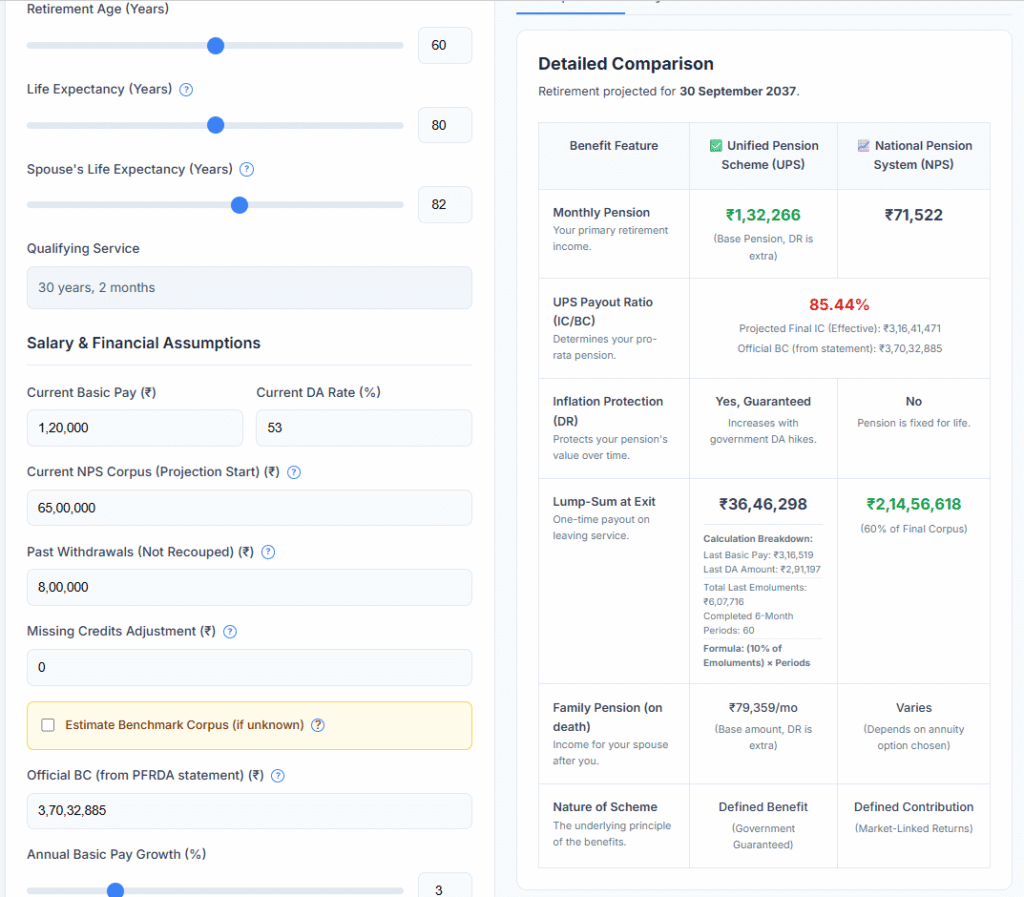
- Current NPS Corpus: ₹ 65,00,000
- Past Withdrawal (Unpaid): ₹ 8,00,000
- NPS Return: 7.5% (Underperforming)
Critical Calculator Settings:
- Estimate Benchmark Corpus (Checkbox):Unchecked ❌
- Official BC (Input Value): ₹ 3,70,32,885 (approx 3.70 Cr)
- Note: This represents what the corpus should have been if the employee had earned 9% returns and made no withdrawals.
Projected Results (Exit Date: 30 September 2037)
- Qualifying Service: 30 Years, 2 Months
1. Unified Pension Scheme (UPS)
- Projected Full Pension: ₹ 1,54,802
- Penalty Ratio (IC/BC):85.44%
- (Your projected IC of ₹ 3.16 Cr is only 85% of the Official BC of ₹ 3.70 Cr, due to the withdrawal and low returns)
- Final Monthly Pension: ₹ 1,32,265 + DR
- (Calculated as 85.44% of the Full Pension)
- Lump Sum: ₹ 36,46,298 (~₹ 36.5 Lakhs)
- (10% × Last Emoluments × 60 Six-Month Periods)
2. National Pension System (NPS)
- Total Corpus: ₹ 3,57,61,029 (~₹ 3.58 Crore)
- Monthly Pension (Fixed): ₹ 71,522
- Lump Sum (60%): ₹ 2,14,56,617 (~₹ 2.15 Crore)
Analysis: This scenario demonstrates how UPS protects employees even in the worst possible financial circumstances. The individual joined service early (2007) but experienced a “double deficit”:
1️⃣ Poor NPS returns of just 7.5%, well below the 9% benchmark, and
2️⃣ A large unreturned withdrawal of ₹8 lakh, which significantly eroded long-term growth.
Because “Estimate BC” is unchecked, the calculator compares the employee’s projected IC of ₹3.16 crore against the Official Benchmark Corpus (BC) of ₹3.70 crore. The shortfall produces an IC/BC ratio of 85.44%, resulting in a proportionate reduction of the UPS pension. Even after this penalty, the employee still receives a substantial ₹1.32 lakh per month (plus DR) — a testament to the resilience of salary-linked benefits.
On the NPS side, the underperformance becomes more stark. The final corpus grows to ₹3.58 crore, which is decent but insufficient to generate a competitive retirement income. The resulting NPS annuity is ₹71,522 per month, far lower than the UPS pension. This showcases how sensitive NPS is to bad market years and early withdrawals; every misstep compounds over time, reducing the final annuity.
Overall, even with penalties applied, UPS delivers significantly greater income security — offering an 85% higher monthly pension compared to NPS. For employees who have faced market underperformance or financial disruptions, the defined benefit structure of UPS serves as a strong safety net, protecting retirement dignity.
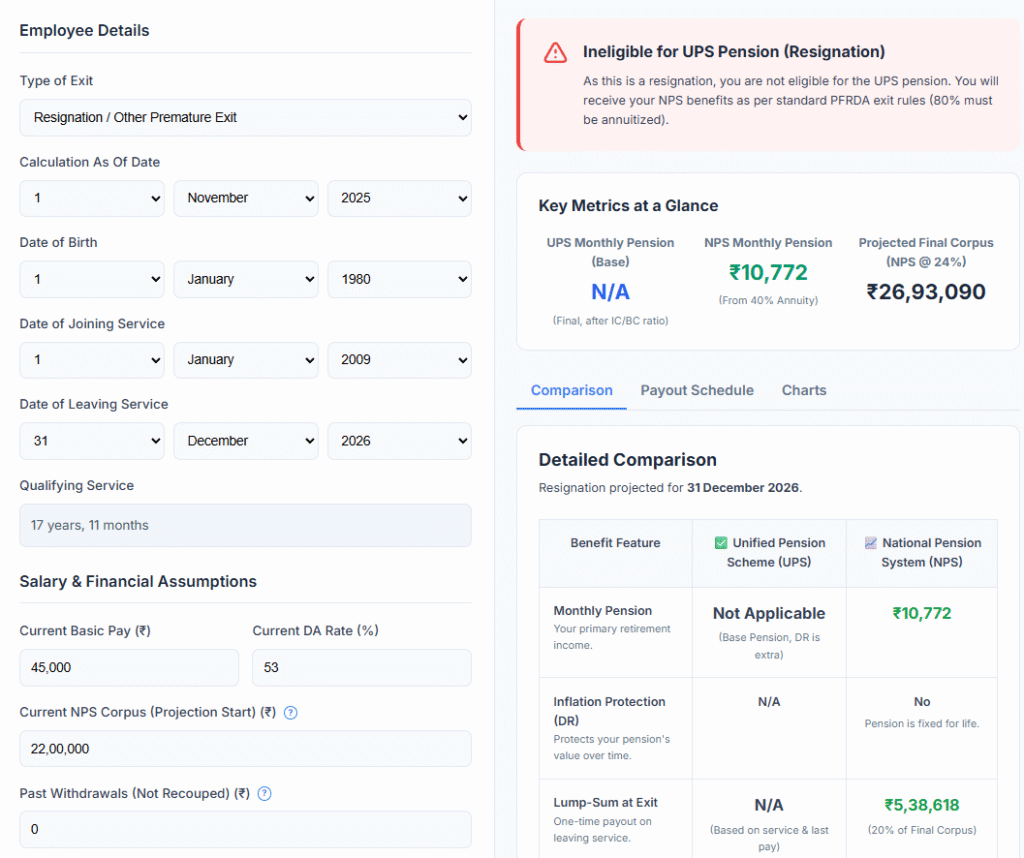
Example 6: Resignation (Immediate Exit)
An employee who decides to leave government service.
Profile & Inputs:
- Exit Type: Resignation
- Date of Birth: 01 January 1980
- Date of Joining Service: 01 January 2009
- Current Basic Pay: ₹ 45,000
- Current DA Rate: 53%
- Current NPS Corpus: ₹ 22,00,000
- Exit Date: 31 December 2026 (Resigning next year)
Projected Results (Exit Date: 31 Dec 2026)
- Qualifying Service: 17 Years, 11 Months
1. Unified Pension Scheme (UPS)
- Eligibility:Not Eligible ❌
- Gazette Rule: “Assured Payout shall not be available in case of resignation.”
- Monthly Pension: ₹ 0
- Lump Sum: ₹ 0
2. National Pension System (NPS)
- Total Corpus: ₹ 26,93,090
- Lump Sum (20%):₹ 5.38 Lakhs (Paid immediately)
- Note: PFRDA rule for resignation mandates 80% annuity purchase, leaving 20% as lump sum.
- Monthly Pension (Immediate):₹ 10,772
- (Annuity purchased from remaining corpus
Analysis: NPS is the Only Option. This is the critical trade-off. If you resign, UPS gives you nothing—no pension, no lump sum, zero benefits.
- The NPS Safety Net: You still own your accumulated money. You walk away with ₹ 27.4 Lakhs of value (split between cash and a small pension).
- Verdict: NPS provides portability and ownership. UPS binds you to the service; if you leave voluntarily (resign) before retirement age, you lose everything.
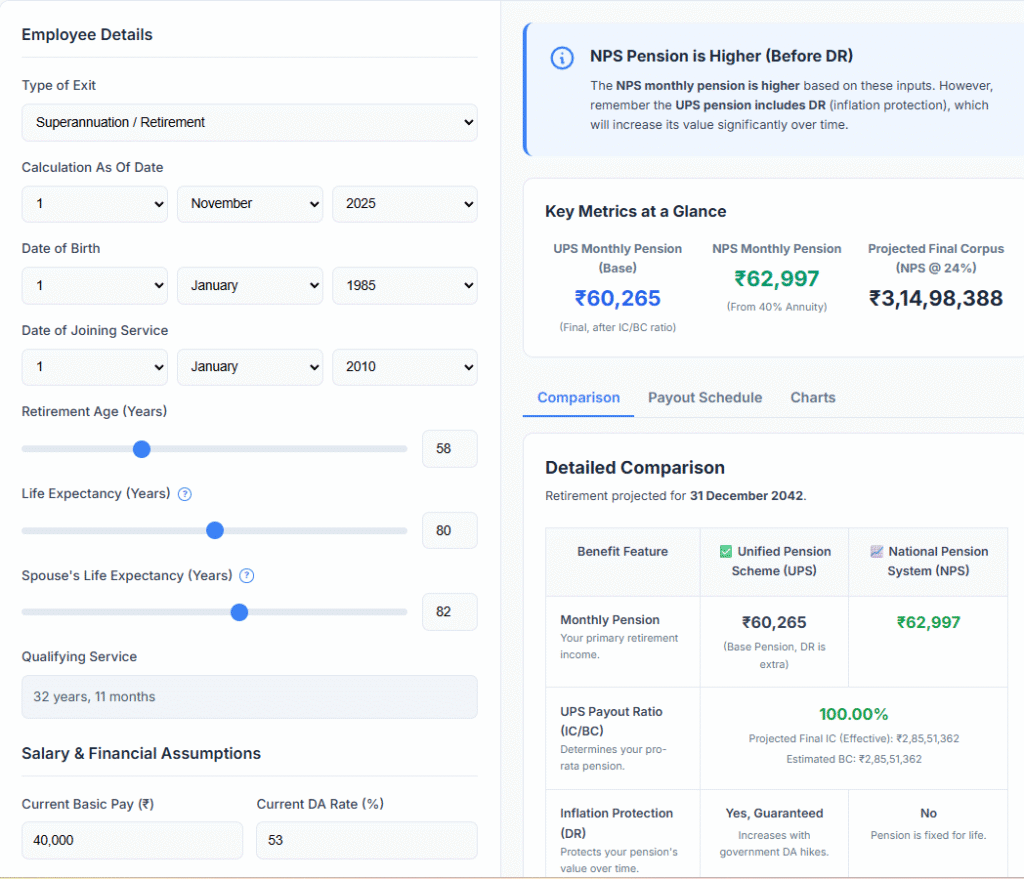
Example 7: Strategic Wealth Accumulation (NPS Wins)
An employee with a healthy starting corpus (₹ 25L) who stays invested in the default fund until retirement at 58.
Profile & Inputs:
- Exit Type: Superannuation
- Date of Birth: 01 January 1985
- Date of Joining Service: 01 January 2010
- Retirement Age: 58 (Exit: 31 Dec 2042)
- Current Basic Pay: ₹ 40,000
- Current DA Rate: 53%
- Current NPS Corpus:₹ 25,00,000
- (Slightly higher starting balance to maximize compounding effect)
- NPS Return: 10% (Standard/Default Fund Performance)
Projected Results (Exit Date: 31 Dec 2042)
- Qualifying Service: 32 Years, 11 Months
1. Unified Pension Scheme (UPS)
- Monthly Pension:₹ 60,265 + DR
- (50% of Avg. Basic ₹ 1.20 Lakhs)
- Lump Sum:₹ 18.4 Lakhs
- (10% of emoluments × 66 periods)
2. National Pension System (NPS)
- Total Corpus: ₹ 3.15 Crores
- Monthly Pension (Fixed):₹ 62,997
- (Standard 40% Annuity)
- Lump Sum (60%): ₹ 1.89 Crores
Analysis: NPS is Favorable for Both Income & Wealth. This scenario highlights a situation where NPS genuinely outperforms UPS — both in terms of retirement income and total wealth. The employee begins with a strong starting corpus of ₹25 lakh, which is significantly higher than typical for someone earning a ₹40,000 basic pay. Combined with consistent contributions and 10% average returns, the market has enough time and capital to compound aggressively over the remaining 17 years.
Under UPS, the employee receives a predictable and stable pension of ₹60,265 per month (plus DR) based on the projected average basic salary of ₹1.20 lakh. While secure and inflation-linked, this remains bound by salary growth, which is structurally slower than market compounding.
With NPS, the employee’s corpus grows to ₹3.15 crore, enabling a fixed annuity of ₹62,997 per month—slightly higher than the UPS pension, even without DR. More importantly, NPS delivers a massive lump sum of ₹1.89 crore, more than ten times bigger than the UPS lump sum of ₹18.4 lakh.
This example proves that when an employee has a healthy early corpus and strong long-term market performance, NPS can deliver higher pension + far greater wealth. It is the ideal scenario for disciplined investors who start early, stay consistent, and let compounding work over time.
UPS vs NPS Calculator: What the Results Mean
Choosing between these two is the central dilemma. There is no single “best” answer; the right choice depends on your risk tolerance, financial discipline, and belief in your investing skills. Our ups vs nps calculator provides the numbers, but this comparison explains the “why.”
Side-by-Side Comparison Table
| Feature | ✅ Unified Pension Scheme (UPS) | 📈 National Pension System (NPS) |
| Pension Type | Adjusted Target Benefit. (Target = 50% basic, adjusted by IC/BC ratio). | Defined Contribution. Pension depends entirely on your final corpus and annuity rates. |
| Inflation Protection | Yes. Pension and family pension increase with Dearness Relief (DR). | No (Standard). Standard annuity is fixed for life. (Increasing options exist but start lower). |
| Market Dependence | Moderate. Your IC performance is measured against the BC benchmark. | High. Your entire corpus and final pension are 100% market-dependent. |
| Family Pension | Fixed 60% of your original assured pension (plus DR). Not affected by IC/BC. | Varies. Depends entirely on the annuity option you purchase (e.g., “Joint Life”). |
| Excess Corpus | Refunded. If IC > BC, the excess is paid to you as a lump sum. | N/A. The entire corpus is yours. |
| Investment Choice | Limited. You can choose NPS patterns, but must be mindful of the BC benchmark. | Broad. Full flexibility (Active/Auto, E/C/G, multiple Fund Managers). |
| Govt. Contribution (to your fund) | 10% | 14% |
Who Should Choose UPS vs. NPS? (A Decision Guide)
This ups vs nps calculator will give you the data, but here is a simple guide to help you decide.
✅ You should strongly consider the Unified Pension Scheme (UPS) if:
- You value security and inflation-protection above all. The Dearness Relief (DR) on the pension is the single biggest advantage and protects you for life.
- You are a disciplined, “hands-off” investor. The best way to ensure your IC matches your BC is to never make partial withdrawals and let the default investment plan do its work.
- You worry about family protection. The 60% family pension (with DR) that is not affected by your IC/BC ratio provides a very strong safety net.
- You are risk-averse and do not want to worry about a market crash just before you retire.
📈 You might be better off with the standard National Pension System (NPS) if:
- You are an expert-level, aggressive investor. If you are confident you can beat the ‘default’ fund’s return by a significant margin over 30+ years, your 24% contribution in NPS could create a much larger corpus.
- You need maximum flexibility. NPS allows you to make partial withdrawals (though it’s not recommended) without a direct penalty to a “target” pension.
- You want a larger lump sum. The 14% vs 10% government contribution means the NPS corpus will likely be larger, leading to a larger 60% lump sum at retirement.
- You understand and accept the inflation risk and plan to manage it yourself by investing your larger lump sum.
Understanding Your UPS Pension After 60
A key feature of the UPS is what happens after you retire (e.g., after age 60 or 58).
- Dearness Relief (DR) Continues: Your pension is not fixed. When the government announces Dearness Relief for serving employees (e.g., a 4% hike), that same hike will be applied to your UPS pension.
- How it Works: If your base UPS pension is ₹50,000/month, a 4% DR hike adds ₹2,000 to your monthly pension, making it ₹52,000. The next hike is calculated on the original base pension.
- NPS vs. UPS: This is the biggest long-term difference. A standard NPS annuity of ₹50,000/month will still be ₹50,000/month 15 years later, by which time its real purchasing power will have been cut in half by inflation. The UPS pension will have grown to protect your lifestyle.
Try the UPS vs NPS Comparison Tool
See the difference for yourself. Use the ups vs nps calculator at the top of this page to run your numbers and see the long-term impact of Dearness Relief in the “Payout Schedule” tab.
Risks, Caveats, and Practical Tips
This is a financial tool, not financial advice. Your decision should be made carefully.
- “Not Guaranteed” Disclaimer:UPS does not guarantee a fixed pension. The final pension is a “target” that depends on your IC/BC ratio at exit. A low IC/BC ratio will result in a proportionately lower pension.
- “Taxability” Disclaimer: The taxability of the UPS lump-sum benefit and other components will follow the final Government/Income Tax notification.
- NAV Variance Disclaimer: Your IC’s value changes daily with the market NAV. The BC is a regulatory calculation. They will not match perfectly.
- Return Uncertainty Note: All projections in this ups calculator are based on assumptions (e.g., 9% return). Actual market returns are not guaranteed and will vary.
- Policy Change Notice: The UPS is new. The rules in the 2025 Gazette are subject to change or clarification by the Government or PFRDA.
- The IC/BC Risk is Real: We cannot stress this enough. If you opt for UPS, you are committing to never using the partial withdrawal facility, or you must repay it.
- BC Performance is Unknown: The ups calculator estimates the BC’s performance for illustration. The actual ‘default pattern’ return is variable and will be published by PFRDA. The goal is to stay reasonably close to BC; exact matching is not required because IC naturally varies with NAV and asset allocation.
Frequently Asked Questions (FAQs)
Here are answers to the most common questions about the UPS and our calculator.
External References & Legal Notes
The calculations and explanations on this page are based on our interpretation of the official government notification. This ups calculator is an estimation tool for illustrative purposes only and does not constitute financial advice. All calculations are projections and are not guaranteed.
For the official legal text and final, binding rules, you must refer to the official sources.
- UPS Rules: The Central Government Gazette Notification (No. 27, F. No. FX-1/3/2024-PR) dated January 24, 2025.
- NPS & BC Rules:Pension Fund Regulatory and Development Authority (PFRDA), which will issue the final operational regulations for calculating the Benchmark Corpus and managing the scheme.
Conclusion
The introduction of the Unified Pension Scheme is a significant, government-backed step for Central Government employees, offering a path to a stable, inflation-protected retirement.
However, as we’ve shown, it is not a simple “guarantee” like the Old Pension Scheme. The UPS is a ‘target benefit’ model that introduces a new layer of personal responsibility. Your final pension is directly linked to your financial discipline—specifically, your commitment to not making premature withdrawals and keeping your investment performance reasonably close to the default fund.
The choice between the UPS’s security (with its IC/BC risk) and the NPS’s flexibility (with its market and inflation risk) is a deeply personal one. This ups vs nps comparison and calculator is designed to be your first and most powerful tool in making that decision. By modeling your own numbers, assumptions, and scenarios, you can move from uncertainty to clarity.
Compare Your Pension Options Now
You’ve read the guide, you’ve seen the examples. Now it’s time to take action.
Disclaimer:
This UPS (Unified Pension Scheme) Calculator is an independent, educational, and illustrative tool created solely for general awareness. It is not an official calculator and is not affiliated, endorsed, or approved by the Government of India, PFRDA, EPFO, MoF, or any government department.
All calculations are prepared using publicly available information and the formulas referenced from the official Government Gazette notification F. No. FX-1/3/2024-PR and related circulars. However, UPS rules, PFRDA regulations, and government notifications may change over time. Actual pension benefits depend on official records, service history, withdrawals, missing credits, partial withdrawals, and department-wise verification.
The results shown by this calculator are estimates only and may differ from the final benefits determined by your department, PFRDA, or the Government of India. For accurate, authoritative, and legally valid information, users must consult their departmental DDO/Accounts Office, official UPS documentation, and the latest PFRDA rules and Gazette notifications.
This tool does not provide financial advice. The website, its authors, and tool creators are not responsible for any errors, omissions, losses, or interpretations arising from the use of this calculator.
Use this tool only for informational and educational purposes.