
Mortgage Payment Calculator – Free Advanced Calculator with APR, Amortization, PMI, Extra Payments & Refinance Options
Easily explore how extra payments, PMI, and refinancing affect your mortgage, visualize your loan progress, and see potential savings over time
Mortgage Payment Calculator
Provided by Lifegic.com
Mortgage Payment Calculator
Welcome to a tool designed to bring clarity and confidence to one of the most important financial decisions of your life. Getting a mortgage can feel complex and intimidating, but it doesn’t have to be. This free Mortgage Payment Calculator is your personal, all-in-one dashboard, created to help you easily figure out your estimated monthly payments, understand your total interest costs, and see the exact date you can celebrate being completely mortgage free. It’s a powerful planning tool built to help you explore and compare a wide variety of financial situations, whether that means finding a strategy to pay off your loan faster or figuring out if a mortgage refinance is the right move for you.
For too long, homeowners have felt like passengers on a 30-year journey they couldn’t control. This calculator puts you in the driver’s seat. Whether you’re a first time home buyer trying to understand what you can afford, a current homeowner looking to optimize your finances, or an investor analyzing a new property, this tool is designed for you. It transforms confusing numbers and industry jargon into a clear, actionable plan, moving you from financial uncertainty to financial empowerment. Let’s begin the journey from dreaming about a new home to confidently holding the keys. If you’re still in the planning phase, our House Affordability Calculator can help you figure out what price range fits your income before running mortgage numbers.
Making Sense of Your Mortgage
Getting a mortgage is about more than just money; it’s one of the biggest and most exciting financial steps you’ll ever take for yourself or your family. It’s about creating a home, building a future, and making a long term commitment. But the process of getting there can be incredibly confusing, often making it difficult to see the true, total cost of your loan or to spot hidden opportunities for saving a significant amount of money over the years.
Borrowers are frequently handed a mountain of paperwork filled with confusing jargon and financial metrics that are anything but intuitive. Documents like the Loan Estimate and Closing Disclosure are meant to provide clarity, but they can often raise more questions than they answer. Even after you reach the milestone of getting a pre-approval letter from a lender, you’ll find that this is really just the beginning of your financial deep dive. That letter provides the basic outline—the loan amount (principal), the interest rate, and the loan term—but these figures are just the skeleton of a much larger and more complex financial picture.
This naturally leads to a series of critical questions that every home buyer faces.
The Three Big Questions Every Home buyer Asks
- “What will I really have to pay each month?” The number a lender quotes you is often just the principal and interest. But your actual out-of-pocket cost will be higher. This calculator helps you uncover the final, all-inclusive monthly payment by factoring in all the pieces of the puzzle.
- “Where is my money actually going?” It can be disheartening, especially in the early years of a loan, to see how little your loan balance seems to drop each month. A huge portion of your initial payments goes directly to interest, not to building your own equity. Understanding this allocation is key to knowing how your loan works.
- “What’s the grand total I’ll pay for this house?” When you add up all the payments over 30 years, the final number can be shocking. A 30-year term is a massive commitment, and the total interest paid can sometimes be more than the original loan amount itself. Without a clear view of this total outlay, the loan can feel abstract and overwhelming, leaving you feeling like you’re not fully in control of your own financial journey.
The real challenge for most people isn’t the mortgage itself, but the lack of a simple, accessible tool to translate all this complex financial data into a coherent, actionable strategy that you can understand and use.
The Problem: Why Mortgage Math Can Be Tricky
The main reason understanding a mortgage can be so challenging is that the numbers you see advertised or quoted upfront often don’t represent the full financial reality. This gap between expectation and reality can lead to painful budget shortfalls and, worse, missed opportunities to save tens or even hundreds of thousands of dollars over the life of your loan. Gaining a clear understanding of these common complexities is the first and most important step toward sound financial planning.
Here are the most common issues that create financial confusion for borrowers, broken down in simple terms.
Interest Rate vs. APR: Uncovering the Real Cost of Your Loan
Lenders love to prominently feature the interest rate in their advertising because it’s the direct percentage cost of borrowing money, and a lower number always looks better. However, the Annual Percentage Rate (APR) is the number you should really be focusing on, as it provides a much more accurate and complete measure of a loan’s total cost.
Think of it like booking a flight. The interest rate is the base ticket price, but the APR is the final cost after you add in taxes, baggage fees, and other charges. The APR takes the interest rate and bundles it with the majority of lender fees, origination charges, and other closing costs associated with getting the loan. This is why a loan offer with a lower advertised interest rate can, and often does, have a higher APR due to substantial fees, making it the more expensive option over time. Comparing loans using the APR ensures you are making a true apples-to-apples comparison.
PITI: The Four Parts of Your Real Monthly Payment
Many home buyers are surprised when their first mortgage bill is higher than they expected. This is usually because they were only thinking about their “P&I” payment. Your actual monthly obligation, often called “PITI,” is almost always higher.
- P (Principal): This is the portion of your payment that goes toward paying down the actual amount of money you borrowed. Every dollar of principal you pay increases your ownership stake, or equity, in your home.
- I (Interest): This is the cost of borrowing the money, paid to the lender. In the early years of your loan, this makes up the largest part of your payment.
- T (Taxes): This refers to your property taxes, which are assessed by your local government. Your lender will typically collect 1/12th of your annual property tax bill each month and hold it in a special account called an escrow account.
- I (Insurance): This refers to your homeowner’s insurance, which protects your home against damage. Just like with taxes, the lender collects 1/12th of your annual insurance premium each month and pays the bill on your behalf from your escrow account.
These escrow payments for taxes and insurance can increase your base P&I payment by a very significant margin, so it’s critical to include them in your budget.
Don’t Forget the Other Potential Costs
On top of PITI, a couple of other mandatory costs can further inflate your total monthly payment.
- Private Mortgage Insurance (PMI): This is a notable example, typically required for conventional loans where the down payment is less than 20% of the property’s purchase price. PMI is insurance that protects the lender (not you) in case you default on the loan. It can add a considerable amount to your monthly payment, but the good news is that it can eventually be removed.
- Homeowners Association (HOA) Fees: If you purchase a property within a condominium complex or certain planned communities, you will likely have a recurring monthly HOA fee. These fees cover the costs of maintaining shared amenities and common areas.
The Hidden Power of Strategic Payments
It’s nearly impossible to intuitively grasp the incredible long-term financial impact of making seemingly small, consistent changes to your payment schedule. However, the mathematics of amortization heavily reward any early and consistent reduction of your principal balance.
Think of your loan principal as a large weight. The interest is the force of gravity constantly pulling on it. Your regular payment is designed to slowly lighten that weight over 30 years. But every extra dollar you throw at the principal is like giving it a powerful upward boost, reducing the amount gravity (interest) can act upon, not just this month, but for every month going forward. These minor strategic actions can yield disproportionately large benefits over several decades, yet these benefits remain completely invisible without the proper calculation tools to forecast them.
Financial Illustration 1: The Effect of Modest Additional Payments. Consider a $300,000 loan at a 6% interest rate over 30 years. Applying an extra $50 per month directly to the principal from the very first payment would result in over $29,000 in total interest savings and would shorten the loan term by 2 years and 1 months.
Financial Illustration 2: The Effect of Payment Frequency. Using that same $300,000 loan, if a borrower shifts from a monthly to a biweekly payment schedule (paying half the monthly amount every two weeks), they make the equivalent of one extra full payment per year. This change in frequency alone would save over $76,000 in interest and shorten the loan term by 5 years and 7 months.
These powerful and achievable outcomes require a tool capable of clearly and accurately forecasting their effects.
The Solution: An Advanced Mortgage Payment Calculator
This is precisely where sophisticated calculation brings clarity and control. This is not a rudimentary loan payment calculator designed to produce a single, isolated estimate. It is an advanced mortgage planning dashboard, engineered to provide a holistic and comprehensive view of a borrower’s financial options and obligations.
This tool was specifically developed to move beyond the basic, initial question of “What is my payment?” and to provide definitive, data-driven answers to the more critical strategic questions that can change your financial future:
- How can the total interest paid over the life of the loan be minimized? This isn’t just about saving money; it’s about building wealth that you can use for other important goals, like retirement or your children’s education.
- What is the precise date on which the mortgage will be fully paid off under various scenarios? See a clear finish line and watch it get closer with every strategic decision you model.
- Is a potential refinance offer financially advantageous when all costs are considered? Move beyond the sales pitch and make a decision based on cold, hard math.
- What are the financial implications of leveraging a property’s value through a cash-out refinance? Understand the true costs and benefits before you borrow against your home’s equity.
- What is the true, all-inclusive cost of the loan, factoring in all fees, taxes, and insurance? Get the one number that truly matters for your monthly budget.
This calculator is designed to empower you, the user. It helps transform the mortgage from a static, long-term liability into a dynamic financial instrument that you can actively manage and optimize to your advantage. You are no longer just a passenger on a 30-year ride; you are the driver with a powerful GPS guiding you to the best possible destination.
Features That Put You in Control
This Mortgage Payment Calculator integrates a full suite of professional-grade features. Each one is designed to illuminate a different facet of the mortgage process and provide you with clear, actionable data.
Find the True APR (Your Secret Weapon for Comparing Loans)
The Annual Percentage Rate (APR) is the unified standard for comparing the total cost of different loans, and this calculator includes a built-in APR solver. When you enter your loan details and any relevant fees, the tool applies an iterative financial algorithm to compute the effective APR with precision. ou can read more about APR in this Investopedia guide
Why it matters: APR gives you the real borrowing cost by combining both the interest rate and closing costs. This helps you spot situations where a “low advertised rate” with high fees may actually cost more than a slightly higher rate with minimal fees.
Complete Amortization Schedule (Your Personal Mortgage Payoff Roadmap)
The calculator generates a full amortization table that shows:
- Payment dates
- Principal vs. interest portions
- Total interest accumulated
- Remaining balance
You’ll see how your loan balance decreases over time, when you cross the point where principal overtakes interest, and how different strategies accelerate your payoff. For a standalone view of payment breakdowns, you can also try our Amortization Chart Calculator.
Extra Payments & Lump Sums (Your Toolkit for Debt Demolition)
This feature lets you model how paying more toward your mortgage shortens the term and reduces interest:
- Recurring Extra Payments: Add a fixed extra amount to every monthly payment, instantly re-amortizing the loan.
- One-Time Lump Sums: Enter large payments (bonuses, refunds, inheritance, etc.) on specific future dates. The calculator applies them to your balance at the next payment cycle, saving you interest and months (or even years) on your loan.
Biweekly Payments (The “Set It and Forget It” Strategy)
Switching to biweekly payments (half the monthly payment every two weeks) results in 26 half-payments per year, which equals 13 full payments. This extra annual payment goes directly toward your principal, cutting interest and accelerating your loan payoff—without major changes to your monthly budget.
Housing Costs: Escrow, PMI & HOA (Get a Real-World Monthly Number)
To make your estimate realistic, the calculator includes fields for:
- Property Tax & Home Insurance (Escrow): Enter as either amounts or percentages.
- PMI (Private Mortgage Insurance): For conventional loans with a down payment below 20%, PMI is a standard requirement. This calculator allows for its inclusion to ensure it is factored into your total monthly obligation.
- HOA & Other Fees: Capture regular monthly obligations.
These fields ensure your estimated monthly cost reflects your true out-of-pocket expense.
Simple Refinance Modeling (Test New Loan Terms)
If you’re considering refinancing, the calculator allows you to:
- Input a new interest rate and term length
- Add closing costs
- Adjust the loan amount (optional for cash-out scenarios)
It then shows the new monthly payment, total interest paid, and updated payoff date compared with your current loan.
(Note: This is a straightforward refinance tool—it models payoff and interest under new terms, but does not calculate advanced metrics like break-even points, for detailed analysis check out our Mortgage Refinance Calculator)
Charts, Reports & Printing (Visualize Your Progress)
- Balance Over Time Chart: See how your loan balance drops with standard vs. accelerated strategies.
- Interest Comparison Chart: Quickly compare total interest across repayment options.
- Printable Reports: Export a professional report with results, charts, and amortization tables for record keeping or discussion with a financial advisor.
Reliability and Trust (Validation & Edge-Case Handling)
The calculator is built with robust input checks—catching invalid or missing entries—and correctly handles special cases (like a 0% interest loan). It also ensures your final payment is adjusted to land your balance at exactly zero.
Try the Mortgage Payment Calculator above now—enter your numbers and test APR, extra payments, and refinance scenarios.
How to Use the Mortgage Payment Calculator: A Step-by-Step Guide
Follow this structured guide to leverage the full analytical power of this tool. For optimal accuracy and the most meaningful results, it’s highly recommended to have a loan estimate or a current mortgage statement on hand before you begin.
Step 1: Enter Your Core Mortgage Details
This section defines the fundamental parameters of the loan you are analyzing.
- Mortgage Amount: Input the total principal amount to be borrowed. Remember, this is the property’s purchase price minus your down payment.
- Interest Rate (%): Enter the annual interest rate quoted by your lender for the loan.
- Mortgage Term (years): Input the full length of the loan, which is typically 15 or 30 years.
- Mortgage Start Date: Select the date of your first scheduled mortgage payment. This is essential for accurate amortization, timeline calculations, and the correct application of any future-dated lump sum payments.
- Down Payment: Enter the initial amount you are paying upfront. You can use the toggle switch to enter this value as a specific monetary amount or as a percentage (%) of the total home value.
Step 2: Input Mortgage Fees for Accurate APR (Optional)
Expand the “Mortgage Fees (for APR)” accordion to input the various one-time fees associated with originating your loan. Entering these figures is crucial for calculating the Annual Percentage Rate (APR), which reflects the true cost of borrowing. This information can be found on your Loan Estimate document.
- Origination Fee: The lender’s fee for processing the loan, typically 0.5% to 1% of the loan amount.
- Discount Points: Prepaid interest you can pay to the lender to lower your interest rate.
- Underwriting / Processing Fee: A standard charge for the service of evaluating and preparing the loan package.
- Appraisal Fee: The cost for a professional appraiser to determine the home’s value.
- Other Lender Fees: A field to consolidate smaller charges, such as application fees, credit report fees, or flood certification fees.
Step 3: Add Your Monthly Housing Costs (Optional, but Highly Recommended)
Expand the “Monthly Housing Costs” accordion to input your ancillary expenses. This step is critical for calculating your true total monthly payment, often referred to as PITI (Principal, Interest, Taxes, and Insurance).
- Property Tax (Annual): This figure can be found on a current mortgage statement or a property tax bill. For prospective purchases, it is often available on real estate listings or can be estimated by looking at the tax history of similar homes.
- Home Insurance (Annual): This is the premium for your homeowner’s insurance policy, available from your insurance provider.
- HOA Fees (Monthly): Enter this value only if the property is subject to Homeowners Association dues.
- PMI (Monthly): For loans with a down payment of less than 20%, Private Mortgage Insurance (PMI) is typically required. Your lender will provide this figure on your Loan Estimate. If you leave this as 0 and your down payment is less than 20%, the calculator will estimate it for you.
Step 4: Build Your Accelerated Payoff Strategy
This is the creative part where you can model various debt reduction strategies to see their potential impact.
- Pay Biweekly: Simply toggle this option on to activate the biweekly payment model and select a start date. This results in one extra full monthly payment per year, significantly shortening your loan term.
- Extra Monthly Payment: Input any additional amount you wish to apply to the principal with each monthly payment.
- Lump Sum Payments: Click the “Add Lump Sum Payment” button to create a new input row. Enter the amount of the one-time payment and the date you plan to make it. You can add multiple lump sums to model various future financial events like bonuses or inheritances.
Step 5: Model a Refinance Scenario (Optional)
For users considering a mortgage refinance, expand the “Refinance Mortgage Options” section to perform a detailed analysis.
- New Interest Rate (%) & New Term (years): Enter the terms of the prospective new loan offer.
- Closing Costs: Input the estimated closing costs associated with the new loan. This is a critical variable for an accurate break-even analysis.
- Refinance Date: Select the date on which the new refinanced loan would become effective.
Step 6: Calculate and Analyze Your Comprehensive Report
Click the “Calculate Payoff” button. The tool will instantly generate a full analytical report below the input section, containing a top-line summary, a strategy comparison table, interactive charts, and a complete, payment-by-payment amortization schedule.
Pro Tip: In the final report, while a lower monthly payment is nice, the most critical metrics for evaluating any strategy are “Total Interest” and “Payoff Date.” An effective long-term strategy will always seek to minimize the former and accelerate the latter.
Examples & Walkthroughs
The following examples illustrate how the Mortgage Payment Calculator can be applied to common real-world financial scenarios to provide clarity and guide your decisions.
Example 1: Calculating a Standard Mortgage Payment
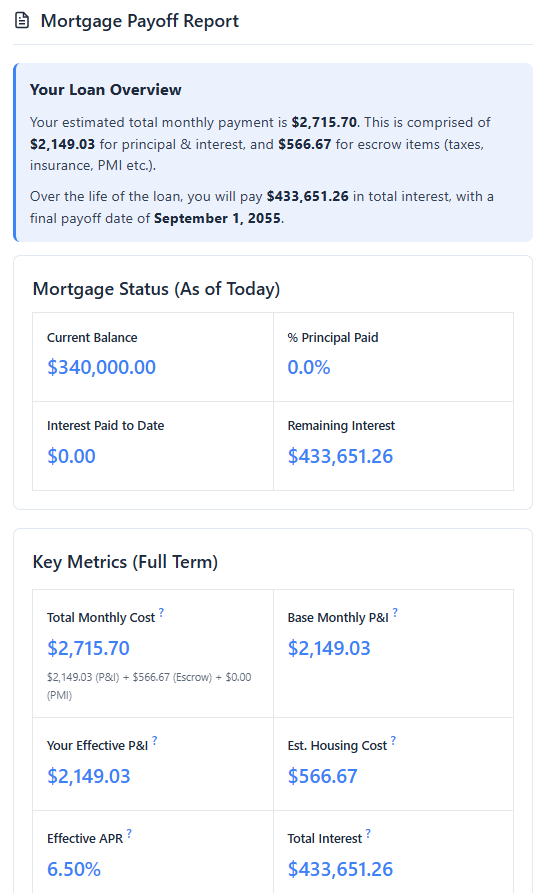
A homebuyer purchases a property for $425,000 with an $85,000 down payment (20%), leaving a loan amount of $340,000.
Inputs:
- Mortgage Amount: $340,000
- Interest Rate: 6.5%
- Loan Term: 30 years
- Property Tax: $5,000 annually
- Home Insurance: $1,800 annually
Expected Outputs:
- Principal & Interest (P&I): $2,149.03
- Taxes & Insurance (Escrow): $566.67
- Total Monthly Payment: $2,715.70
- Total Interest Paid: $433,651.26
Interpretation:
The borrower’s true monthly housing cost is $2,715.70, not just the $2,149.03 P&I. The eye-opening detail is that the borrower will pay over $433,000 in interest across the loan term — exceeding the original loan balance. This highlights why exploring faster payoff strategies is critical.
Example 2: The Power of Extra Payments
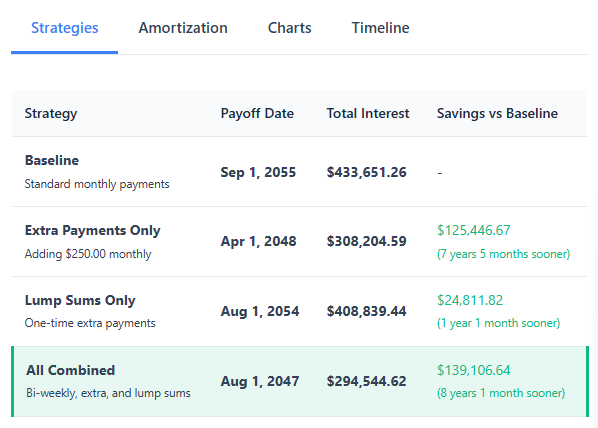
The borrower decides to make an additional $250 per month and apply a $5,000 lump sum payment from a work bonus after two years.
Inputs:
- Base loan details kept same as Example 1
- Extra Monthly Payment: $250
- Lump Sum: $5,000 (after 2 years)
Expected Outputs:
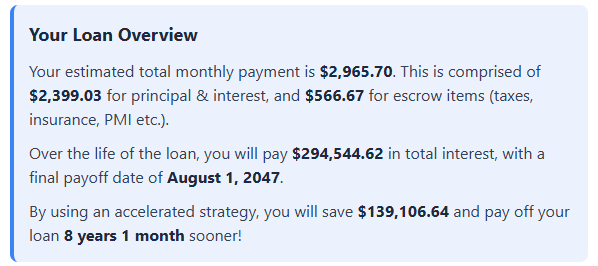
- New Payoff Date: 8 years and 1 months earlier
- Total Interest Paid: $294,544.62
- Total Interest Savings: $139,106.64
Interpretation:
This disciplined approach slashes over $139,000 in interest and shortens the loan term by more than 8 years. A modest monthly boost and a single bonus payment transform the mortgage into a faster wealth-building tool, accelerating financial freedom.
Example 3: The Biweekly Advantage
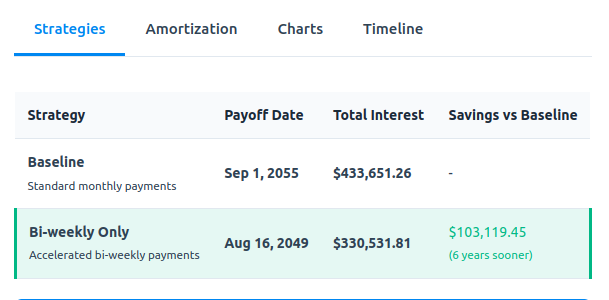
Instead of extra payments, the borrower opts for a biweekly payment schedule, paying $1,074.56 every two weeks instead of $2,149.12 monthly.
Inputs:
- Input loan details same as Example 1
- Payment Frequency: Biweekly
Expected Outputs:
- New Payoff Date: ≈ 6 years sooner
- Total Interest : $330,531.81
- Total Interest Savings: $103,119.45
Interpretation:
By simply changing the payment cadence, the borrower pays off the mortgage nearly 6 years sooner while saving over $103,000 in interest. This effortless strategy requires no ongoing budget increase once set up.
Example 4: The Refinance Comparison
After 5 years, the borrower’s remaining balance is $318,277. With lower rates available, a lender offers a 30-year refinance at 4.75% with $6,000 in closing costs.
Inputs:
- Original loan details from Example 1
- Refinance after 5 years
- New Interest Rate: 4.75%
- New Term: 30 years
- Closing Costs: $6,000
Expected Outputs:
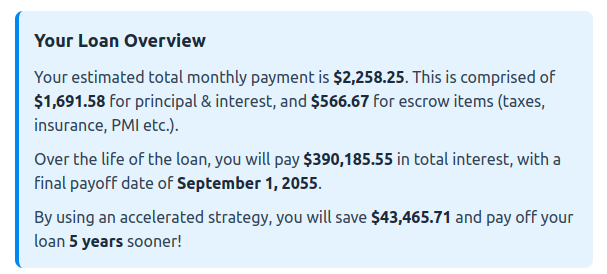
- New Monthly P&I: $1,691.58
- Monthly Savings: $457.45
- Total Lifetime Interest Savings: $43,465.71
Interpretation:
The refinance lowers the monthly payment by nearly $457 and saves over $43,000 in lifetime interest. This makes the refinance a financially sound move for borrowers planning to stay in the home long term.
Example 5: Understanding the Impact of PMI (Auto-calculated by the Calculator)
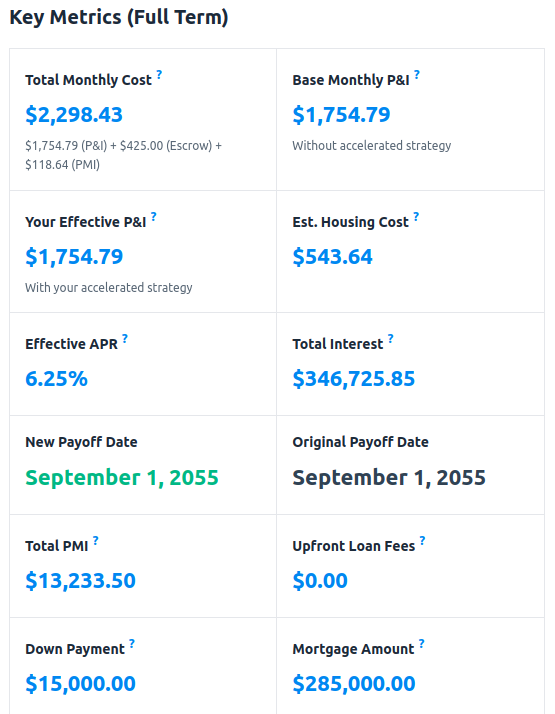
A first-time homebuyer purchases a $300,000 home with a 5% down payment ($15,000). This leaves a loan amount of $285,000 on a 30-year fixed mortgage at 6.25%. Because the down payment is below 20%, the calculator automatically adds PMI until the borrower’s loan-to-value ratio reaches 80%.
Inputs
- Home price: $300,000
- Down payment: $15,000 (5%)
- Loan amount: $285,000
- Term: 30 years
- Rate: 6.25% fixed
- PMI: Automatically calculated by the tool (~$118.64/month initially)
Outputs (from calculator)
- Principal & Interest (P&I): $1,754.79
- Escrow (Taxes + Insurance + PMI): $543.64
- Total Monthly Payment: $2,298.43
- PMI included: ~$118.64/month
- PMI duration: Until ~September 1, 2035 (≈ 10 years after loan start)
- Total PMI paid before removal: $13,233.50
- Final payoff date: September 1, 2055
- Total interest paid (P&I only): $346,725.85
Interpretation
The calculator shows how PMI meaningfully increases the monthly cost. Instead of just the $1,754.79 mortgage payment, the borrower pays $2,298.43/month, which includes escrow items and PMI. PMI is automatically scheduled to drop off around September 2035 once the loan-to-value reaches 80%, reducing the monthly cost by about $118.64. Over that period, the borrower will have paid $13,233.50 in PMI premiums — a cost they can plan to eliminate once equity builds up.
A Note on Accuracy & Assumptions
This calculator is a professional-grade modeling tool designed for educational and planning purposes. Its calculations are based on established, industry-standard financial formulas. To ensure consistency and clarity, it operates under a few standard assumptions:
- Fixed-Rate Loans: The calculations assume a fixed interest rate that will not change over the life of the loan. The tool is not designed to model the complexities of Adjustable-Rate Mortgages (ARMs).
- Taxes and Insurance: These are calculated based on the annual figures you provide. In practice, property tax assessments and insurance premiums can and often do change annually, which could lead to adjustments in a real-world escrow payment.
- PMI: The calculator includes the PMI payment for the duration of the loan as entered. In reality, under the Homeowners Protection Act, borrowers can typically request PMI cancellation once their loan-to-value ratio reaches 80%, and lenders must automatically terminate it when the loan is scheduled to reach a 78% loan-to-value ratio.
Key Terms & Glossary
- Amortization: The process by which a loan principal is reduced over time through a series of fixed payments. The amortization schedule is the table that itemizes this process payment by payment.
- Annual Percentage Rate (APR): The total cost of a loan to a borrower, including the interest rate and all fees, expressed as a single annual percentage.
- Closing Costs: A collection of fees and expenses incurred by the buyer and seller to finalize a real estate transaction, including origination fees, appraisal fees, and title insurance.
- Closing Disclosure: A five-page form that provides final details about the mortgage loan you have selected. It includes the loan terms, your projected monthly payments, and how much you will pay in fees and other costs to get your mortgage (closing costs).
- Down Payment: The portion of a home’s purchase price that is paid upfront by the buyer in cash and is not part of the mortgage loan.
- Equity: The difference between your home’s current market value and the amount you still owe on your mortgage. It is the portion of the property you truly own.
- Escrow: A legal arrangement in which a third party temporarily holds money or property until a particular condition has been met. In mortgages, it refers to the account managed by the lender to hold your funds for property taxes and homeowner’s insurance.
- Fixed-Rate Mortgage: A mortgage loan where the interest rate remains the same for the entire loan term, providing a stable and predictable monthly payment.
- Loan-to-Value (LTV): A financial ratio used by lenders to assess risk, comparing the loan amount to the market value of the property.
- Principal: The amount of money originally borrowed from a lender, excluding any interest charges.
- Private Mortgage Insurance (PMI): Insurance required on conventional loans with a down payment of less than 20% that protects the lender from loss in case of borrower default.
- Points (Discount Points): Fees paid directly to the lender at closing in exchange for a reduced interest rate. One point costs 1 percent of your mortgage amount.
- Refinance: The process of replacing an existing mortgage with a new one, typically to secure a lower interest rate, change loan terms, or take cash out of the home’s equity.
Frequently Asked Questions (FAQ)
Take Control of Your Financial Future
A mortgage represents a significant and long term financial obligation. However, it is also the key to home ownership and a powerful tool for building long term wealth. With precise information and strategic planning, it can be managed effectively to support your financial goals. This journey from confusion to clarity begins with understanding the numbers that drive your financial life.
This Mortgage Payment Calculator provides the necessary data driven insights to understand all your available options, to make informed and strategic decisions, and to confidently execute a plan for achieving your version of financial freedom, one payment at a time.
Use the Mortgage Payment Calculator now—test your scenario and download the amortization schedule
Disclaimer:
This Mortgage Payment Calculator is intended for informational and educational use only and does not constitute financial advice. The results are estimates derived from the data you provide. It is essential to consult with a qualified lender or financial advisor for official loan estimates and professional advice tailored to your specific financial circumstances.