
Rate of Return Calculator | Free IRR & CAGR Calculator
Find your real investment growth with our free Calculate Rate of Return Calculator. Get accurate CAGR and IRR results, compare returns, and plan smarter.
Rate of Return Calculator
Provided by Lifegic.com
We all want our money to work for us. Whether you’re diligently saving in a 401(k), investing in the stock market, or just stashing cash in a high yield savings account, the goal is the same: growth. But how do you know if your strategy is actually working? Is your money growing fast, slow, or not at all? It’s surprisingly hard to tell. Sure, your account balance might be higher than it was five years ago, but how much of that is your own contributions versus actual investment gain? And how does that growth compare to other investments? This is where you need a single, powerful number to cut through the confusion. That’s why we built this free tool to help you calculate rate of return instantly.
This page provides more than just a simple tool; it’s a complete guide to understanding your investment performance. For many people, finance feels intimidating. Our goal is to make it clear. This calculate rate of return calculator is designed to demystify your returns, helping you move from “guessing” to “knowing.” It takes your unique situation—including any regular deposits or withdrawals—and gives you a precise, annualized return. This one number can help you track your progress, compare your options, and make smarter, more confident financial decisions.
Understanding the Rate of Return in Real Life
So, what is a “rate of return”?
In the simplest terms, the rate of return is a percentage that tells you the “speed” of your investment’s growth (or loss) over a specific period. Think of it as a grade for your money. If you put $1,000 into an investment and a year later it’s worth $1,100, your total return is $100, or 10%. That 10% is your rate of return. It’s the most important metric for an investor.
But this simple example gets complicated in the real world. This is where it’s crucial to understand the difference between a few key concepts:
- Total Return: This is the total profit or loss as a percentage of your original investment, ignoring time. In our example, $10,000 turning into $15,000 is a 50% total return. But this metric is incomplete. Was that 50% over one year (which is amazing) or 20 years (which is terrible)?
- Annualized Return: This is the real “speed” we’re looking for. It’s the average, year-over-year return. This is the only way to compare different investments. A 10% annualized return on Investment A is clearly better than a 7% annualized return on Investment B, regardless of how long you held them. Our calculate rate of return calculator specializes in finding this number.
- Compounded Growth: This is the engine of wealth. It’s the concept of your returns earning their own returns. Your “interest earns interest.” When you calculate your compounded return, you’re acknowledging that the 10% you earned in year one becomes part of the principal that earns another 10% in year two.
Why is this so important? For personal investors, it’s everything. Knowing your annualized rate of return helps you answer the most critical questions in your financial planning:
- Am I on track for retirement? If your plan requires an 8% average return and you’re only getting 4%, you need to make a change.
- Is my investment strategy working? This calculate rate of return calculator helps you grade your own performance.
- Am I beating inflation? If your return is 3% but inflation is 4%, you are losing purchasing power. Your money is worth less, even though your balance is growing.
How do I compare two different funds? You can’t compare a 5-year-old fund to a 10-year-old fund without a rate of return calculator to find the annualized rate for both.
How Our “Rate of Return Calculator” Works
When you use this tool, it’s actually running one of two different “engines” under the hood. It’s smart enough to know which one your situation requires. You don’t need to choose; you just need to accurately describe what you did with your money.
Engine 1: CAGR (Compound Annual Growth Rate)
This is the engine the calculator uses for simple scenarios. “Simple” means you put money in at the start (Initial Investment), didn’t add or remove any money, and then saw what it was worth at the end (Final Value).
CAGR tells you the smooth, average annual growth rate that would have been required to get your investment from its starting value to its ending value, assuming the growth was compounded every year.
Analogy: Think of CAGR as finding your average speed on a long road trip. You might have driven 80 mph on the highway and 30 mph through towns. But if you traveled 300 miles in 5 hours, your average speed was 60 mph. CAGR is that single, steady growth rate that (metaphorically) gets you to the same destination in the same amount of time. It’s the best way to measure a simple, lump-sum investment.
Engine 2: IRR (Internal Rate of Return)
This is the “advanced” engine, and it’s what makes our calculate rate of return calculator so powerful. This engine kicks in as soon as you open the “Advanced Contributions” section and add a regular deposit or withdrawal.
Why? Because the real world isn’t simple. Most of us don’t just invest one lump sum. We add $100 to our brokerage account every month. We contribute to our 401(k) with every paycheck. We might even take money out of an investment.
This is where CAGR breaks down. It can’t handle those extra cash flows. IRR, on the other hand, is built for it.
IRR, also known as the money-weighted return, is a much smarter metric. It understands a profound financial concept: The Time Value of Money. This concept means that a dollar today is worth more than a dollar a year from now, because the dollar you have today can be invested and start earning returns.
The IRR calculator logic understands that a $100 deposit in Year 1 had more time to grow and “worked harder” for you than a $100 deposit in Year 5. It finds the single, unique discount rate (your rate of return) that accounts for the exact timing and amount of all your cash flows—your start, your end, and everything you put in or took out in between.
In short:
- Use CAGR (Simple Mode): To find the return on a single lump-sum investment.
- Use IRR (Advanced Mode): To find your true, personalized return on an investment with regular contributions or withdrawals (like a 401(k), an IRA you add to, or a brokerage account).
Our tool auto-detects this. If you add contributions, it automatically becomes a powerful IRR calculator. If you don’t, it uses CAGR. This ensures you always get the most accurate and realistic measure of your investment performance, fully matching U.S. financial standards.
✅ Don’t just read about it. Try it! Enter your own numbers above in the Calculate Rate of Return Calculator and see how your money could have grown!
Why the Rate of Return Matters More Than You Think
It’s easy to get lost in the numbers, but the reason we calculate rate of return isn’t just for a report card. It’s about making better decisions. This one metric is the foundation of intelligent financial planning.
Tracking Your Portfolio’s “Health”
Think of your rate of return as a vital sign for your financial health, like your blood pressure or heart rate. You wouldn’t go a decade without a check-up, so why let your life savings go un-checked? A regular portfolio analysis is essential.
Maybe you feel like your investments are doing well, but the numbers might tell a different story. Perhaps an old 401(k) from a previous job is lagging, pulling down your average. This calculate rate of return calculator gives you a quick, objective snapshot. It helps you spot problems (like a fund that’s performing worse than its benchmark) and opportunities (like a strategy that’s clearly working).
Comparing Apples to Apples (The Only Way)
This is perhaps the most important use. Let’s say you’re looking at two mutual funds.
- Fund A: Has a 75% total return.
- Fund B: Has a 40% total return.
Which is better? You have no idea. Fund A’s 75% might have taken 12 years (a mediocre ~4.8% CAGR), while Fund B’s 40% took just 4 years (a solid ~8.8% CAGR).
Total returns are marketing. Annualized returns are math.
You must use an annualized return to make a fair comparison, and that’s exactly what this investment return calculator is built to do. It levels the playing field, allowing you to compare a 10-year-old investment to a 3-year-old investment and see which truly performed better on a year-over-year basis.
Realistic Financial Planning and Goal-Setting
How much do you need to save for retirement? The answer to that question depends almost entirely on the rate of return you expect to earn.
- If you assume a 10% compounded return, you might reach your goal by saving $500 a month.
- If you assume a 5% compounded return, you might need to save $1,200 a month to reach the same goal.
Using a tool like our calculate rate of return calculator to see what your actual historical performance has been gives you a realistic baseline for your future projections. If you’ve been averaging 7% for the last decade, it’s more prudent to use 7% in your retirement plan than to blindly hope for 12%. This tool grounds your expectations in reality, which is the cornerstone of successful long-term financial planning.
Making Smarter Investment Decisions
Should you sell a poor performing asset? Should you buy more of a winner? Should you add an international fund to your portfolio?
You can’t make these decisions based on a “gut feeling” or a hot tip. You need data. This calculate rate of return calculator provides the central piece of data you need. For example, you can use it to:
- Evaluate a single stock: See the CAGR of that one stock you bought five years ago.
- Analyze your “fun” portfolio: See if your attempts at stock-picking are actually beating a simple index fund. (Hint: for most people, they aren’t).
- Check your financial advisor: If you pay an advisor, you can use this tool to track their investment performance and hold them accountable.
This moves you from being a passive passenger in your financial life to being an active, informed driver.
The Formulas: Behind-the-Scenes Logic of the Calculator
You don’t need to do this math yourself—that’s the entire reason we built this calculate rate of return calculator. But for those who are curious, here’s the logic that powers the tool. Understanding how it works can give you even more confidence in your results.
The Simple Case: Compound Annual Growth Rate (CAGR)
When you don’t enter any regular contributions, the calculator uses the CAGR formula, the standard for measuring lump-sum growth over time.
The Formula:
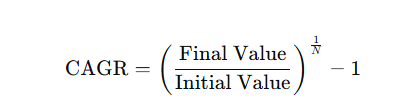
Explanation of Variables:
- Final Value: The ending value of your investment.
- Initial Value: The starting amount you invested.
- N: The total number of years the money was invested. (If you enter months, the calculator converts them—for example, 30 months becomes 2.5 years.)
A Walkthrough:
- Final Value ÷ Initial Value: Divide your end value by your start value to find the total growth multiple (e.g., $15,000 ÷ $10,000 = 1.5).
- ^(1 / N): This step takes the Nth root of that growth multiple (e.g., the 5th root if N = 5 years). It annualizes the total growth, smoothing it into an average yearly growth factor.
- – 1: Subtracting 1 converts the factor into a percentage (e.g., 1.084 – 1 = 0.084, or 8.4%).
And just like that, you have your annualized return.
The Advanced Case: Internal Rate of Return (IRR)
When you include regular contributions, the calculator switches to calculating IRR. This is more complex. Unlike CAGR, IRR cannot be solved with a simple formula. Instead, the calculator uses an iterative, high-speed “guess-and-check” method (technically a solver like the Newton-Raphson method) to find the one rate that satisfies the equation:
The Conceptual Formula:

Explanation of Variables:
- PV (Present Value): Your initial investment, treated as a negative number (money going out).
- CF₁, CF₂… (Cash Flows): Regular contributions or withdrawals, negative for deposits and positive for withdrawals.
- FV (Future Value): Your final value, treated as a positive number (money coming in).
- N: Total number of periods (e.g., 60 months for a 5-year investment with monthly contributions).
- IRR (Internal Rate of Return): The single percentage that makes the entire equation equal zero.
This formula accounts for the time value of money, correctly discounting each cash flow based on when it occurred. Our calculate rate of return calculator performs this complex loop in a fraction of a second to find your true money-weighted return.
IRR gives a realistic picture of investment performance, and this calculator brings that power directly to your fingertips. For a deeper explanation, see Investopedia’s Rate of Return Guide.
Using the Calculator: A Simple Step-by-Step Guide
We designed this calculate rate of return calculator to be as intuitive as possible. Here’s a quick walk-through to ensure you get the most accurate results.
Step 1: Enter Your Core Investment Details
This section is for the “big picture” of your investment.
- Initial Investment: This is the starting amount you put in. The “seed” of your investment.
- Final Value: This is what your investment is worth today, or what it was worth when you sold it.
- Investment Length: How long were you invested? Be as precise as you can. 5.5 years is very different from 5 years.
- Duration Unit: Simply tell the calculator if the number you just entered was in “Years” or “Months.”
If this is all you did—a simple lump sum—you can skip Step 2 and hit “Calculate.”
Step 2 (Optional): Add Regular Contributions or Withdrawals
This is the most powerful feature of the rate of return calculator. Click the “Advanced: Regular Contributions” bar to open this section. Use this only if you made consistent, regular payments or withdrawals.
- Contribution Type: Were you adding money (“Regular Deposit”) or taking money out (“Regular Withdrawal”)?
- Regular Amount: What was the positive dollar amount of that regular transaction? (e.g., 100).
- Deposit Frequency: How often did this happen? “Monthly,” “Quarterly,” or “Yearly.”
- Timing of Payment: This is a key detail for financial planning formulas. Were your payments made at the start of the period (like rent) or at the end (more common, like a 401(k) contribution from a paycheck)?
Step 3: Click “Calculate Return”
Once your numbers are in, hit the button. The calculator will instantly process your inputs using either the CAGR or IRR formula, depending on what you entered.
Step 4: Understand Your Results Report
The results report gives you a full, clear picture of your investment gain (or loss).
- Annualized Return (CAGR) / Effective Annual Rate (IRR): This is your main number. It’s your true, year-over-year investment performance. This is the number you should use for comparisons.
- Total Return: The total percentage growth of your investment, ignoring the time it took.
- Total Profit/Loss: The simple, bottom-line dollar amount you made or lost.
- Total Contributions & Total Growth: This is a fantastic breakdown. It separates your final value into two parts: the money you put in (Initial + Contributions) and the money your money made (Total Growth).
Important Note: The results from this investment return calculator are estimates based on the data you provide. They are for informational and illustrative purposes only and should not be considered financial advice.
✅ Ready to see how your portfolio stacks up? Use the calculate rate of return calculator above and discover your personal investment return in seconds
Practical Examples of Calculating Rate of Return
Let’s walk through a few real-world scenarios to show how this calculate rate of return calculator works and what the results tell you.
Example 1: A “Set it and Forget It” Stock Investment (CAGR)
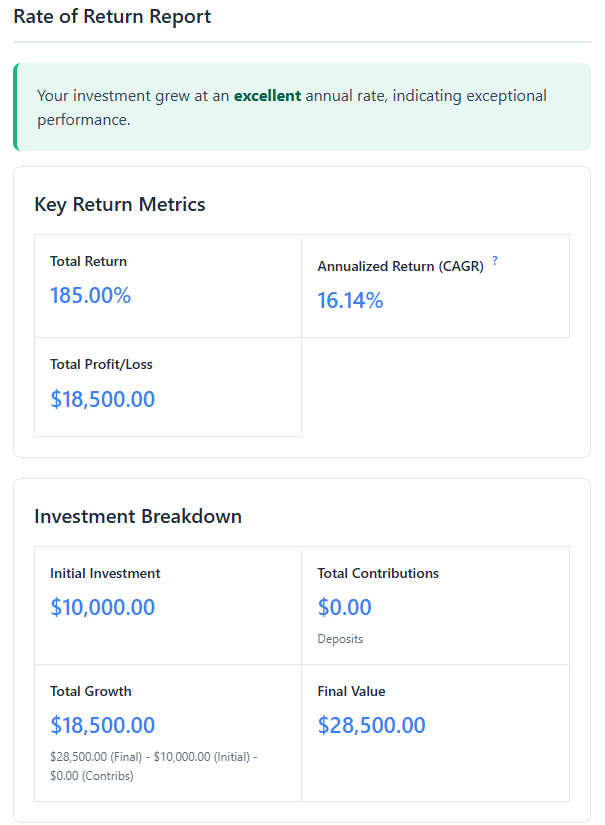
- Scenario: Suppose an investor bought $10,000 worth of a tech index fund (like QQQ) seven years ago and made no additional contributions. Today, the account is worth $28,500. They want to know the annualized return.
- Inputs for the Calculator:
- Initial Investment: $10,000
- Final Value: $28,500
- Investment Length: 7
- Duration Unit: Years
- Advanced Contributions: None
- Results from the Calculator:
- Annualized Return (CAGR): 16.14%
- Total Return: 185%
- Total Profit: $18,500
- Interpretation: The total return sounds impressive, but the real insight is the 16.14% CAGR, which represents the consistent annual growth rate. This allows comparison to other investments, like the S&P 500’s historical 10–12% average over the same period.
Example 2: Consistent Retirement Contributions (IRR)
- Scenario: An investor starts with a $5,000 lump sum in a retirement account and deposits $250 every month for 10 years. At the end of 10 years, the account balance is $62,000.
- Inputs for the Calculator:
- Initial Investment: $5,000
- Final Value: $62,000
- Investment Length: 10
- Duration Unit: Years
- Advanced Inputs:
- Contribution Type: Regular Deposit
- Regular Amount: $250
- Deposit Frequency: Monthly
- Timing: End of period
- Results from the Calculator:
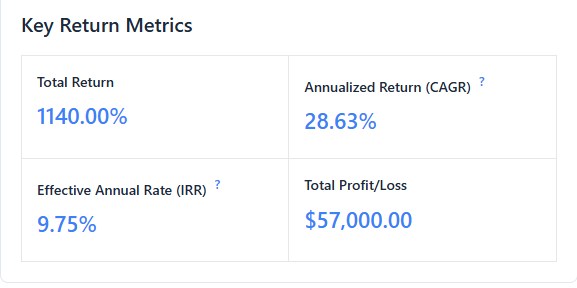
- Effective Annual Rate (IRR): 9.75%
- Total Contributions: $30,000 ($250 × 12 × 10)
- Total Growth: $27,000 ($62,000 Final − $5,000 Initial − $30,000 Contributions)
- Interpretation: The IRR of 9.75% is the true money-weighted return, reflecting both the initial investment and regular contributions over time. It is more meaningful than a simple total return calculation because it accounts for the timing of contributions.
Example 3: Investment with Regular Withdrawals (IRR)
- Scenario: An investment property is purchased for $200,000. The investor withdraws $1,000 every quarter ($4,000/year) from rental income. After 8 years, the property is sold for $270,000. They want to know the annualized return on this project.
- Inputs for the Calculator:
- Initial Investment: $200,000
- Final Value: $270,000
- Investment Length: 8
- Duration Unit: Years
- Advanced Inputs:
- Contribution Type: Regular Withdrawal
- Regular Amount: $1,000
- Deposit Frequency: Quarterly
- Results from the Calculator:
- Effective Annual Rate (IRR): 5.63%
- Total Withdrawals: $32,000 ($1,000 × 4 × 8)
- Total Growth: $102,000 ($270,000 Final − $200,000 Initial + $32,000 Withdrawals)
- Interpretation: A simple CAGR would ignore the $32,000 in withdrawals. The IRR calculation correctly accounts for cash flows over time, showing the project’s annualized return of 5.63%. This allows a fair comparison with other investments over the same period.
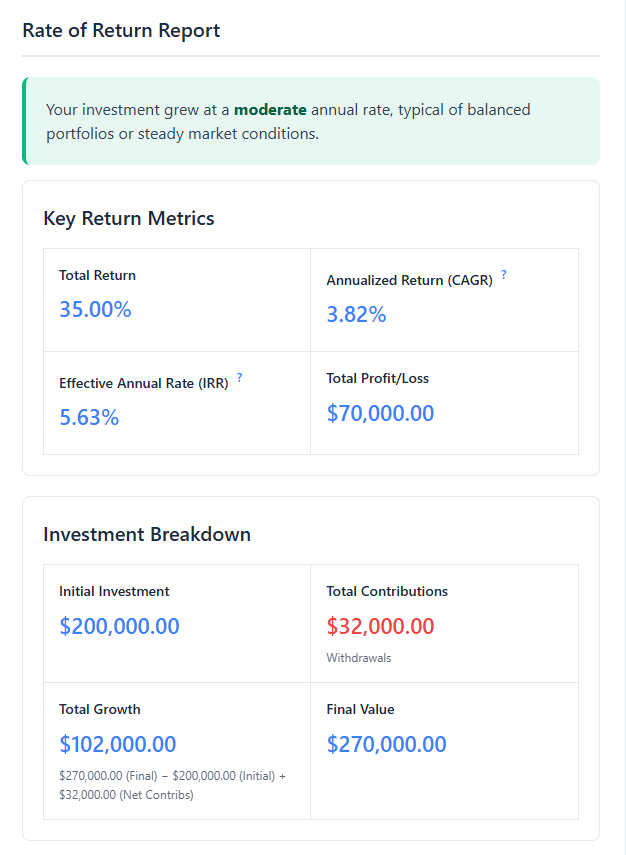
These examples demonstrate how the calculate rate of return calculator handles a variety of scenarios—from simple lump-sum growth to complex contributions and withdrawals—providing the one number that accurately reflects investment performance
Rate of Return vs. Other Financial Metrics (ROI, APY, etc.)
The world of finance is a confusing “alphabet soup” of acronyms. It’s easy to see “return” and think all these terms mean the same thing. They don’t. Using the right metric for the right job is critical. Let’s clear up the confusion.
Rate of Return (CAGR/IRR) vs. ROI (Return on Investment)
- What is ROI? ROI is the simplest, most basic return metric. It’s your total profit divided by your total cost, expressed as a percentage.
ROI = (Total Profit / Total Cost) * 100%
- What’s the Difference? ROI ignores time. A 100% ROI is fantastic if it took 1 year ($10k -> $20k). It’s terrible if it took 25 years. ROI tells you what your return was; it doesn’t tell you how fast it was.
- When to Use Each: Use ROI for a quick, “back-of-the-napkin” calculation on a completed project. (e.g., “I bought that vintage car for $15,000 and sold it for $25,000, my profit was $10,000, so my ROI was 66.6%”). Use an annualized return (from our calculate rate of return calculator) for any investment that lasts more than a year, and for any comparison between two different investments.
Rate of Return vs. APY (Annual Percentage Yield)
- What is APY? You see APY advertised by banks for their savings accounts and Certificates of Deposit (CDs). APY is a forward looking promise. It tells you exactly what your return will be over one year, and it already includes compounding.
- What’s the Difference? APY is promised, guaranteed, and simple. It assumes one deposit and no changes. A Rate of Return (CAGR/IRR) is backward looking and variable. You use our investment return calculator to measure the performance that already happened in a volatile investment like a stock or mutual fund.
- When to Use Each: You use APY when you are shopping for a safe place to park your cash (like a CD). You use our calculate rate of return calculator when you are analyzing the performance of an investment you already own.
Rate of Return vs. Simple Interest
- What is Simple Interest? This is the most basic form of interest, and it’s almost never used in modern investing. It’s calculated only on your initial principal. Your interest never earns its own interest. (e.g., $1,000 at 5% simple interest earns you $50 in Year 1, $50 in Year 2, $50 in Year 3… forever).
- What’s the Difference? The real world runs on compounded return. Our calculate rate of return calculator always uses compounding (via CAGR or IRR). It realistically assumes that your gains from Year 1 become part of the principal that earns gains in Year 2.
- When to Use Each: You’ll almost only see simple interest used for very short term, informal loans. For all investment growth and portfolio analysis, you should only use a compounded metric.
Rate of Return (IRR) vs. TWR (Time Weighted Return)
- This is a more advanced one. Our tool calculates a money weighted return (IRR). The other main type used by professional fund managers is a Time-Weighted Return (TWR).
- What’s the Difference? TWR ignores the timing and amount of your personal cash flows. It breaks the investment’s performance into many sub-periods and measures the pure performance of the fund’s assets. It answers the question: “How did the fund manager do?”
- Our IRR calculator answers a different, more personal question: “How did I do?” Your personal IRR is heavily influenced by your own timing. If you added a bunch of money right before a market crash, your IRR will be worse than the fund’s TWR, because your timing was unlucky.
- When to Use Each: TWR is for evaluating a fund manager. IRR (which our calculator finds) is for evaluating your own personal investment performance and financial planning.
Benefits of Using an Online Rate of Return Calculator
You could try to calculate your IRR in a spreadsheet, or worse, by hand. But the reality is that an online tool is superior for most people. Here’s why using this calculate rate of return calculator is a smart move.
- Accuracy (No More Formula Headaches): The IRR formula is notoriously difficult to solve. Even in Excel, setting up the
RATEorIRRfunction correctly can be finicky. You have to get the negative/positive signs right for all cash flows. Our calculate rate of return calculator has this logic pre-built and validated. - Time Saving and Instant: What might take you 20 minutes of spreadsheet wrangling (or hours of frustration) is done in less than a second. You get an instant, clear answer and can get on with your day.
- Handles Complexity Automatically: The best feature is the automatic switch from CAGR to IRR. You don’t even need to know which formula is appropriate. Just tell the calculate rate of return calculator your situation (lump sum vs. regular deposits), and it grabs the right tool for the job.
- Clear Visual Interpretation: A number like “9.2%” is just a number. Our results report gives you context. By showing you “Total Growth” vs. “Total Contributions,” you can understand the source of your wealth. This is far more insightful than just a single percentage.
- Empowers Your Financial Planning: This is the biggest benefit. Regularly using a rate of return calculator moves you from a passive saver to an active, informed investor. You can track your progress quarter by quarter, hold your investments accountable, and make data-driven decisions about your future.
✅ Bookmark this page and use the Calculate Rate of Return Calculator whenever you track your progress—it’s free and always available.
Frequently Asked Questions (FAQ)
Here are some of the most common questions people have about calculating their investment returns.
Explore Other Financial Calculators
Understanding your investment gain is a huge step in mastering your financial planning. But it's just one piece of the puzzle. We offer a free, easy-to-use tools to help you build a complete financial picture.
Now that you've used our calculate rate of return calculator, why not try one of these next?
- Interest on Interest Calculator: See the true power of compounding in action. A perfect tool for visualizing long-term growth.
- CD Calculator: Compare guaranteed returns from Certificates of Deposit to see how they fit into your financial picture.
We encourage you to explore these tools. Each one is designed to give you clarity and confidence.
From 'Guessing' to 'Knowing' Your Investment Performance
Making smart financial decisions can feel overwhelming. The stock market is complex, retirement seems impossibly distant, and it’s all too easy to just "set it and forget it," hoping for the best.
But hope is not a strategy. True financial confidence comes from knowing. It comes from having clear, simple, and accurate data that tells you exactly how your decisions are paying off.
That is the entire purpose of this calculate rate of return calculator. It's not just about getting a percentage. It's about translating your unique, and often messy, investment journey—with all its starts, stops, contributions, and withdrawals—into a single, understandable number.
When you can measure your investment performance, you can manage it. You can see what's working, what isn't, and make adjustments. You can compare your strategy to other options with a clear, apples-to-apples metric. Using this calculate rate of return calculator is a powerful and simple step toward taking control of your financial future. We hope it helps you on your path to investment growth and lasting financial confidence.